Showing posts with label history. Show all posts

Saturday, 21 November 2015

Reconstructing an early medieval turf house in the Netherlands

This is a time lapse video showing the reconstruction of an 8th century turf farmhouse at the Yeb Hettinga Museum in the village of Firdgum, Friesland, northern Netherlands:


The finished house in November 2015:

(University of Groningen/medievalists.net)

 Firdgum had a population of 100 in 2004, according to Wikipedia, and is located in the fertile salt marshes along the coast of northern Friesland.   

Location of Friesland in the Netherlands (in red).  (Wikipedia)

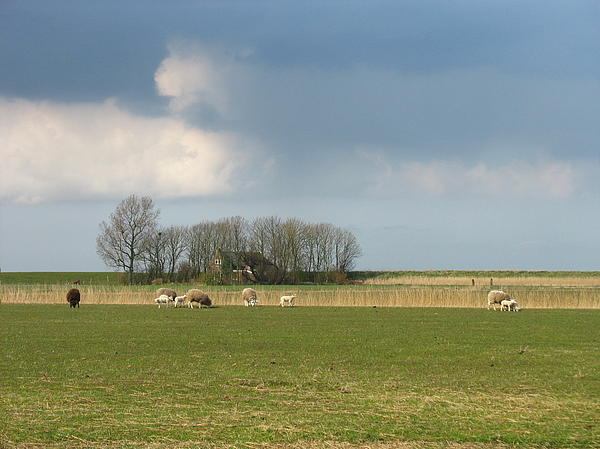
Landscape in Friesland with sheep (source).
 
Horses in a salt marsh in Lauwersmeer, Friesland (source).

In the days before dykes, regular flooding prevented trees from growing in the north of the Netherlands, so very little wood was available to build houses.  Starting around 400 AD, houses there were built on artificial platforms to keep them out of the flood water, and constructed  of stacked clay turf blocks (turves). The walls of this house are a metre thick, which both insulates the house from the cold of the North Sea coast and supports the weight of the roof. 

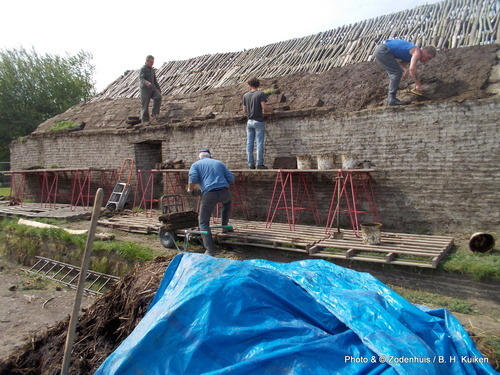
Most of the 8th century house collapsed due to a roof leak in 2013 and was reconstructed starting in 2014 by volunteers, in coordination with the University of Groningen. 

The collapsed house, from a article dated November 2013 (Photo by Jakob Talsma)

 
You can see the exposed rafters of the turf house here.  I'm guessing that's the museum building behind it, but I haven't been able to translate 'Yeb Hettinga Skoalle.'  That might be in Frisian, not Dutch. (Photo by Daniel Postma)

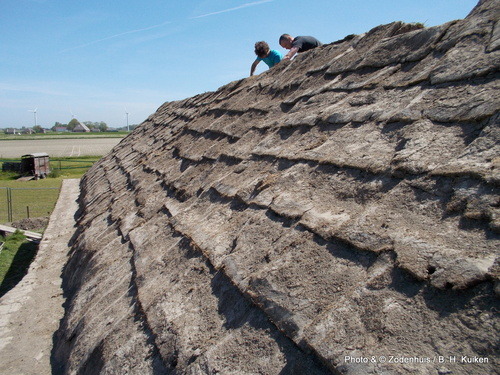
The pre-collapse roof, replaced in the summer of 2013, was made of layers of sod and manure over wooden rafters, but the roof of the 2015 reconstruction is made of thatch over wooden rafters.  I don't know why that might be.

The 2014-2015 reconstruction project was part of Daniël Postma’s PhD research into building traditions in the northern coastal regions of the Netherlands.  Postma published a book, Het zodenhuis van Firdgum – Middeleeuwse boerderijbouw in het Friese kustgebied tussen 400 en 1300 (”The Firdgum sod house: Medieval farmhouse building in the Frisian coastal area between 400 and 1300″) which details the design and construction process of the turf house.  (Description of the book translated by Google).

The medievalists.net article on the reconstruction describes the house:
The [farm house], which is nearly 17 metres long, is characterized by a 1 metre-thick carrier wall made of layered turf, as was customary throughout the region from the fifth to the early eighth century. It is also the first archaeological reconstruction with an arch-shaped roof construction, which clearly distinguishes it from the rectangular trusses of existing historic farmhouses.

I couldn't find more than a couple progress photos of the reconstruction, just the video up top and a few casual photos on the Zodenhuis Project Twitter (mostly in Dutch), but I did find some good quality photos of a roof replacement done on the house in the summer of 2013 on the Zodenhuis Project Tumblr (in Dutch):

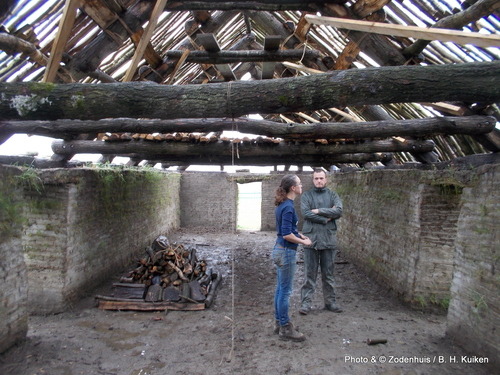
The stripped inside of the house (May 2013)
 
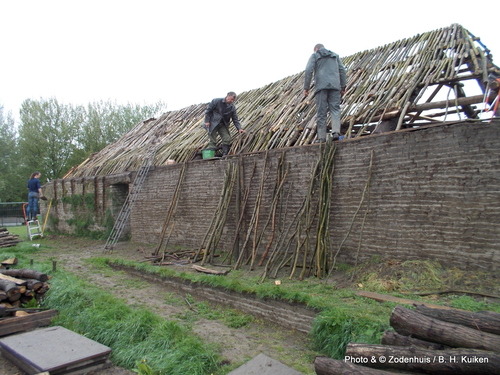
The rafters almost ready to be covered with sod (May 2013)


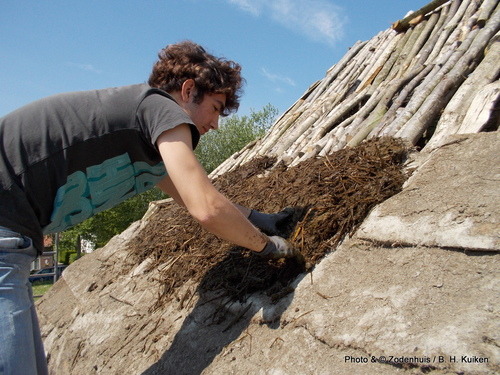
Applying cow manure mixed with straw over top of the turves to provide a waterproof layer (May 2013)


Manure being applied to the first layer of sod (May 2013)


"On the west side the roof of the sod house is now equipped with the first layer of turf. This side now awaits a layer of manure and two layers of sod." (June 2013)


The house after it re-opened to the public later in 2013:

The finished house.  I think those dots are cow patties stuck to the walls to dry.

That little girl is even wearing wooden clogs.  I'm guessing that's early medieval dress (Yeb Hettinga Museum).


Inside the house (Zodenhuis Project, fall 2013)


A pot of something cooking over an open fire inside (Yeb Hettinga Museum).
Houses in prehistoric and early medieval Europe didn't have chimneys, so the smoke from the fire either drifted out through the door, if it was open, or just filtered out through the roof, like this thatched example in Ireland:

From Aidan O'Sullivan on Twitter.
There's a bit more on early medieval Frisian turf houses and this house's construction at Daniel Postma's Tumblr, the  Zodenhuis Firdham Facebook page (in Dutch) and Twitter (mostly in Dutch), the Zodenhuis Project Tumblr (inactive, in Dutch), but I've summarised most of it here. I found a couple academic articles in the links section of the project Tumblr, but I can't read Dutch and that's more than Google Translate can handle.

Thursday, 24 September 2015

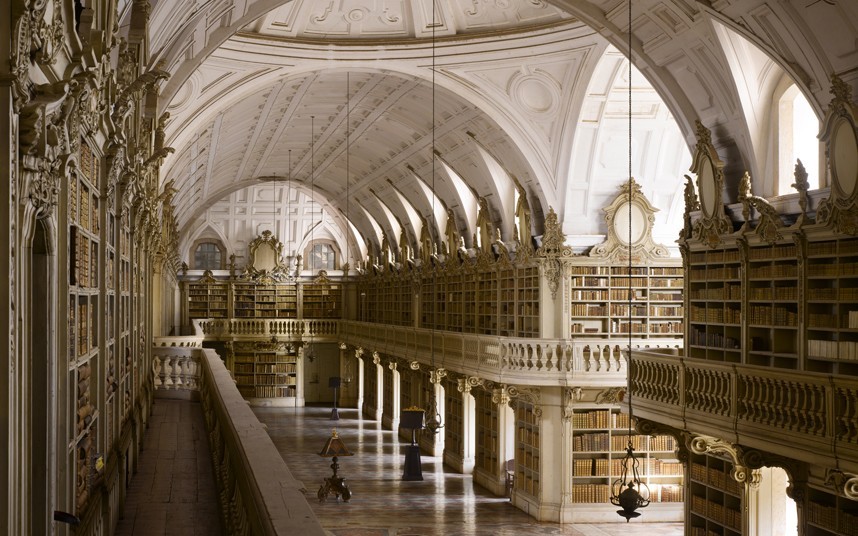
Mafra Palace Library


Mafra Palace Library, Portugal

From The Telegraph:
Since its opening in 1771, the Mafra Palace Library has been home to a colony of tiny bats; they roost behind the cases in winter, and in the orchard outside in the summer, swooping in during the night to eat insects which would otherwise damage the books.
More about the library and the colonial history behind its creation under the cut.

Friday, 7 August 2015

Lawrence of Arabia's Daggers

T.E. Lawrence, British archeologist and later military officer who assisted the Arab forces against the Ottomans during the First World War, had three Arabian daggers he obtained during the desert campaigns, two silver and one gold.  He gave one away, one is held by the University of Oxford, and one was bought at auction last month for nearly two hundred thousand dollars.

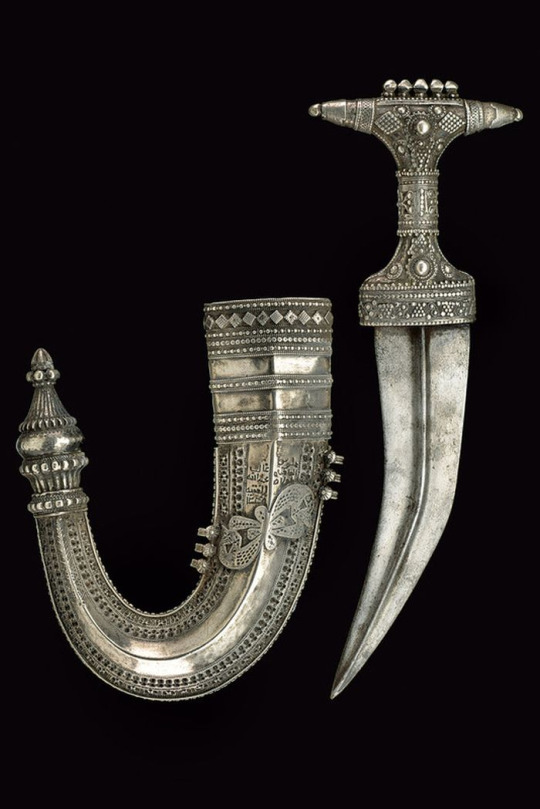
The second silver dagger (Christie's).
Above is the second silver-gilt jambiya dagger (30cm long), gifted to T.E. Lawrence in 1917 by Sherif Nasir at Aqaba after the Arab capture of that town from the Turks.  The dagger was auctioned by Christie’s on July 15, 2015, for a price realised of £122,500 (US $191,713).  (The price realised is the hammer price plus the buyer's premium).

Sherif Nasir was an Arab leader and cousin of Emir Feisal I, a Hashemite prince who was the third son of the Grand Sherif of Mecca, lead the forces of the Arab Revolt against the Ottomans from 1916-18, and was appointed king of Syria and then Iraq after the First World War.  Emir Faisal commanded the Arab forces alongside Abu ibu Tayi in the Battle of Aqaba, with Sherif Nasir participating and Lawrence advising.

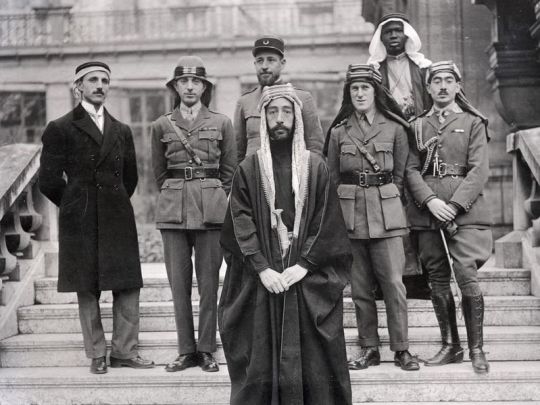
Emir Faisal’s delegation at Versailles, during the Paris Peace Conference of 1919. Left to right: Rustum Haidar, Nuri as-Said, Prince Faisal, Captain Pisani (behind Faisal), T. E. Lawrence, unknown person, Captain Tahsin Kadry (Wikipedia).
 In 1921, Lawrence left the dagger in the possession of sculptor and society hostess Kathleen Scott (widow of Antarctic explorer Captain Robert Falcon Scott), who had seen him at the ballet and not known who he was.  She would later comment to him in a letter that when she had first seen him ‘you had a turban on and I think I thought you had been born in it,’ which makes me wonder why he was wearing a turban to the ballet, who does that.

I have never seen Lawrence in a turban, and they weren’t worn by the Arabs where he was (they still aren’t), so I suspect that when Scott saw him at the ballet he was actually wearing a kefiyyah and agal like he did during the Arab Revolt.  There are many photos of him in one.  Still, why would a Welshman wear that at the ballet.

Scott saw him again at Waterloo station and requested a sitting so she could make a sculpture of him: 
Lawrence acquiesced, stipulating only that she did not ‘do me as Colonel Lawrence (he died Nov. 11. 1918)’. In fact, the resulting sculpture depicted him in just this manner, in full Arab dress, dagger at his waist. Of the sitting on 9 February 1921, Scott wrote: ‘Oh, what a very pleasant day, first Col. Lawrence came. We had great fun about dressing him up in his Arabian clothes, which he finally put on in the drawing room’. After his final sitting on the 20 February, he left the present dagger and robes with Kathleen, that she might continue her work while he sailed to Cairo; it would be over a year later, on the 28 August 1922, that he would write to request their return – ‘There’s a little artist wants to do an Arab picture, & has asked me for kit … Do you think you could provide some from your store?’ – later mentioning in a letter to Lionel Curtis in 1929 (see below) that the dagger still remained in the possession of Lady Hilton Young [Scott having married Edward Hilton Young, later 1st Baron Kennet, in 1922]. No such retrieval was made, and the dagger and the robes have remained in the possession of the family since then.  (Christie’s). 
Lawrence died in a motorcycle accident in 1935 and Lady Kennet died in 1947. This is the only one of Lawrence’s three Arabian daggers known to remain in private hands; it’s being sold by the estate of the last Lady Kennet following her death.

The first silver dagger was given to Lawrence by Sherif Abdullah, elder brother of Feisal and future ruler of the Transjordan. Lawrence presented it as a gift to the Howeitat chiefs in the Wadi Sirhan at the urging of Sherif Nasir - an investment lavishly rewarded by the support of the Bedouin in the assault on Aqaba, according to Christie’s.

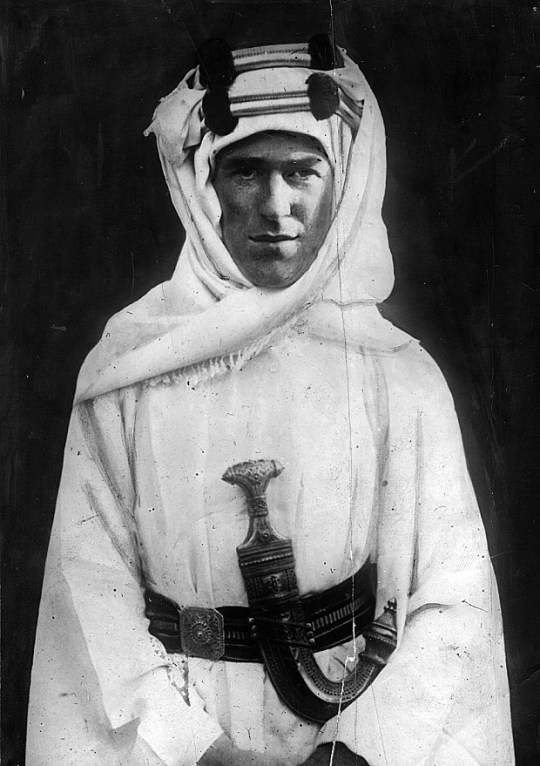
 Lawrence appears with a dagger in many photos, including this one from the Telegraph article about the auction:


 I can't tell which dagger he's wearing. It's not the gold dagger, because the gold dagger is a lot smaller and its front bulges.  I think it might be the first silver-gilt dagger, which he gave away in Arabia, as it looks like the shape’s different from the shape of the dagger in the photo provided by Christie's - the point of the dagger being auctioned curves up all the way to the hilt.

Here's another photo of him in the desert somewhere, taken by B.E. Leeson in 1917.  I can't tell if it's the same dagger here either:

(National Portrait Gallery)
Here's a hand-coloured photo of him from 1917.  His dagger is tinted gold, but that doesn't necessarily mean it was gold.  It's definitely not the same shape or size as the gold dagger held by All Souls:

T. E. Lawrence in a classic pose from a photo in the Metcalf collection, 1917 (The Huntington Library).
 His third, smaller gold dagger was sold to his friend Lionel Curtis for £125, and subsequently presented to All Souls’ College, Oxford.  Lawrence was a research fellow at the college from 1919 to 1926.  The college still holds a thobe Lawrence wore, and the canteen set he used during the campaign.

Lawrence's mother gave these robes to All Souls College after his death, in 1938.  He adopted Arab dress in 1916 after being requested to when he joined the Arab forces, because he felt he could not gain the trust of the Arabs while dressed as a British officer, and because Arab dress was better suited to the desert.


Lawrence wore the dagger, discreetly acquired in Mecca in 1917, during the war; it also appears in the famous Augustus John portrait. He had it made small because a full-size one would have been too cumbersome. After the war he sold it to pay for repairs to his Dorset cottage, "Clouds Hill"; in 1938 it was given to All Souls College.  Lawrence had purchased the head-dress in Aleppo in 1912 and given it to his mother the following year. He recovered it to wear during the war because good quality examples were by then hard to obtain. (source).
About 1917 Lawrence had a canteen set made in Jidda to his own design. It included the plate, bowl, and spoon which he carried and used throughout the desert campaigns (source).
 A Hittite horse and rider. Lawrence kept the terracotta figure in his room at All Souls College in Oxford after the war. It dates from the ninth century BC and comes from the area of his excavations at Carchemish before the war (source).
 I haven’t been able to find a picture of the sculpture of Lawrence that Christie’s says Kathleen Scott made, or any other mention of it anywhere, so I’m not sure if it still exists or who might have it.  In 1920 Scott did cast a sculpture of T.E. Lawrence’s younger brother A.W. Lawrence, who was later Cambridge Professor of Classical Archaeology.  It’s a nude statue called "Youth" of a young man with his arms outstretched, which Kathleen Scott (by then Lady Hilton Young) presented to the Scott Polar Research Institute at the University of Cambridge for the opening of the Institute’s building in 1934.

Lady Hilton Young also presented a number of objects and papers to the Institute in memory of her first husband and his four companions, who died on their return journey from the South Pole in 1912.  The statue of A.W. Lawrence still stands outside the building (you can see it here.  It's a photo of the nude statue from behind).  The Latin inscription on its pedestal – LUX PERPETUA LUCEAT EIS – is translated as "let eternal light shine upon them."

Friday, 24 July 2015

Did a Muslim walk on the moon?

Someone once insisted to me that a Muslim space shuttle made it to the moon before the American one did. She was a teacher I had in college, and she thought that fact proved that Muslims were superior to Americans. I asked her when that was and what the mission was called and she just kept repeating the word for “space shuttle” in Arabic and eventually I gave up.

Some time later I got on the internet and did some Googling in both languages and found out that there was a rumour that Neil Armstrong heard the athan on the moon and converted to Islam there. (The rest of this story is under a cut).

Wednesday, 16 July 2014

Wreck of the Amstelveen

In 1763, the VOC (Dutch East India Company) ship Amstelveen was headed from Batavia in the Dutch East Indies (now Jakarta, Indonesia) for Kharj, Iran with a load of mainly sugar and spices when she wrecked off the coast of Oman.  From the Cultural Heritage website:
On the 5th of August [the Amstelveen] sailed near Ras Madrakah (Cape Mataraca), on the South East coast of Oman. In the evening, as the darkness was setting in and hampered by the foggy conditions, the ship came too close to the coast and ran aground. Due to the very high and powerful waves crashing on and breaking over the ship, she capsized and broke into pieces and sank. On board were 105 men of which 75 of them drowned. Only 30 crewmen reached the shore alive.

Dr. Klaas Doornbos, a retired professor of education and friend of the Dutchman who discovered Eyks' logbook concerning the Amstelveen in an antique market in Southern France in 1997, has written a book about the wreck of the Amstelveen and the subsequent trek across Oman by the survivors,  titled Desert Survival in Oman, 1763: The fate of the Amstelveen and thirty castaways on the South Coast of Arabia.  It's set to be published in English and Dutch by Amsterdam University Press in October 2014, but from the news reports it looks like publishing has been scheduled for some years and has not yet happened.

Doornbos explained in The Week in 2012:

“I am not a professional maritime historian or a cartographer; I am a retired professor. But I was asked to solve the problem of the wreckage. The log that was found was useful, but I couldn’t solve it solely based on that. I used Google Earth and looking at the topography and the map I was able to determine the area where the ship wrecked. We still don’t know the exact location of the wreck because there was no evidence.

The ship was shattered and, I suppose, pillaged later.” Cornelis Eyks was the ship’s third mate and used his talent of writing to keep a detailed log of all the events that transpired from the time the crew set sail from Batavia (Jakarta, Indonesia), headed to Kharg, Iran in 1763.

Of the 30 survivors, 22 arrived in Muscat after an arduous trek that took the survivors from Ras al Matrakah, via Duqm, 500km to Ras al Hadd in Sur. After four days of walking, the survivors reached a cape (the cape of Ras al Matrakah), which helped them realise where they were and where they needed to head in order to reach civilisation in Muscat. They reached Muscat 31 days after they shipwrecked, encountering pillaging Bedouins, compassionate nomads, Arabian oryx and giant sand dunes.

According to AUP's website, Eyks' journal is the oldest European account of the coast of Oman and its inhabitants.

The Dutch Embassy to Oman produced a documentary about the trek and the search for the wreck, in coordination with the Ministry of Heritage and Culture.

More from The Week:

The other 30 would make it to a rocky beach in Ras Madrakah south of Duqm and about 20 of those would live through the torturous walk to Sur and Hadd. One of them would faithfully log the story of the survivors of the Amstelveen, a ship whose story ended in Oman and, almost 250 years later, is about to begin once again.

The subject of a new book as well as a whole new chapter in the relationship between the Netherlands and Oman, interest in the Amstelveen was rekindled recently after a chance discovery of a copy of the log kept by the ship’s third mate Cornelis Eyks. Surfacing in an antiquarian bookstore in the south of France, the log came to the notice of Dr Klaas Doornbos who researched it and wrote Shipwreck & Survival in Oman 1763.

A copy of the manuscript is here in Oman in the care of H E Stefan van Wersch, Ambassador of the Kingdom of the Netherlands to Oman but as it has not been published yet, H E van Wersch has promised the author that he will not pass it on, but he was kind enough to narrate excerpts to us.

“The story is like the TV show Extreme Survival, where they drop someone in a remote place and they have to survive with what they can find, only in this case it was a real life or death struggle,” said H E van Wersch. “These men had to walk some 700km to reach a point from which they were taken by sea to Muscat. And this was in August, so you can imagine the heat they had to deal with.

The log describes how at day they would burn in the sun, their feet in terrible shape from walking without proper footwear on hot sand and rock, and at night though drained they could never sleep properly because of the cold. All of this with a terrible shortage of water.”

As not all of them could maintain the same pace, the survivors thinned out into small groups of twos and fours. Some, possibly injured or just unable to go on any further, would drop and have to be left behind never to be seen again. Perhaps due to some misunderstanding in communication, the men came under attack by some of the people they came across in the desert.

Eyks’ log speaks of being treated with compassion too with some people helping to treat their cracked and burnt lips with some sort of unguent. Some villagers they met also gave them dates and water as well as shelter from the cruel elements to sleep in. “The great thing about the log is what it describes but sadly he leaves so much out. There were many mysteries about the Amstelveen that have not yet been solved,” said H E van Wersch.

One mystery is why it ran aground in the first place. The captain was experienced and would have known these waters. Another enigma is the man whom Eyks met in Muscat who spoke fluent Dutch - he would surely have asked how the man had learnt Dutch but has not recorded that. Some of the anomalies caused the whole wreck story to be treated with suspicion by the Dutch East India Company who suggested that the crew might have fabricated the story and sold off the cargo.

Not sympathetic to the harshness endured by the men, the company sent Eyks to Kharg where he was questioned and from there back to Batavia for another round of interrogation before finally buying his story and paying him his back salary but only up till the day the ship was wrecked. As to the treasure the Amstelveen was carrying? A load of mainly sugar and spices, so there is not much in those rough waters to go diving for - other items such as the cannons, which commanded a good value in those days, would almost certainly have been salvaged shortly after the wreck by whoever learnt about it.
I very much hope the book is eventually published, because it is the only source I can find for this story.


Wreck of the Cromdale

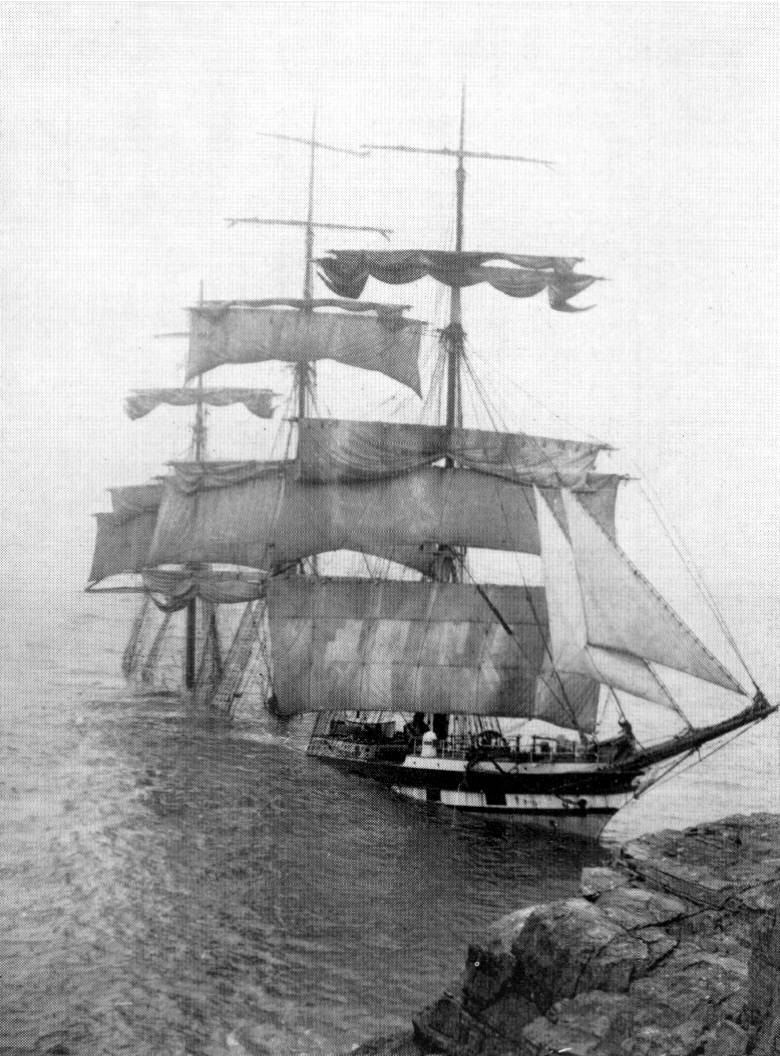
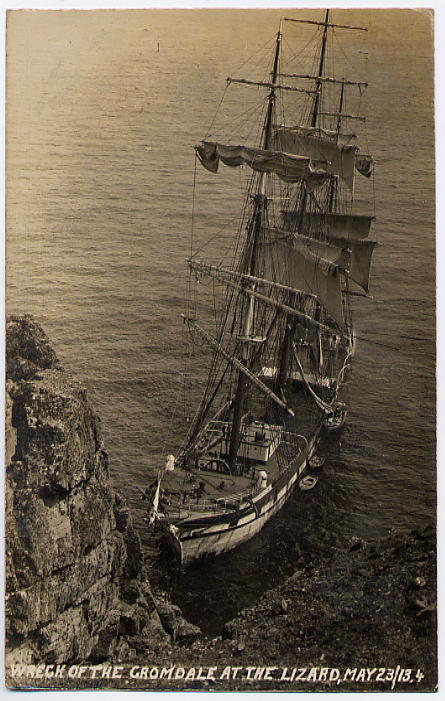
The 1,903-tonne steel barque Cromdale ran aground in heavy fog off the coast of Cornwall in May 1913 while carrying nitrates from Chile to Fowey.  Within ten minutes she had to be abandoned.  All passengers were saved by local lifeboats but the ship was a total loss and within a week the wreck had broken up completely in a heavy gale.  Her steel ribs and masts still lie underwater.

According to the St. Keverne wreck diving site:

The Lizard is not named after some legendary beast - although it is a land where such stories abound. The name actually comes from the Cornish lezou, or headland. The Lizard is, in fact, a peninsula, whose cliffs support the moorland plateau of Goonhilly Downs, some 300ft above sea level.

The Lizard sticks out into the Channel so far that it is the biggest ship trap in British waters. In fact, so many ships have fallen victim to the Lizard's cliffs and underwater reefs that the Admiralty advises navigators to keep three or more miles off in any kind of rough weather. Those who failed to take that advice have made the Lizard a Mecca for today's wreck divers.
 - A Diver's Guide to the Shipwrecks of the Lizard
Wreck of the Cromdale (Image from Helston History website)
The [Mount Stewart and Cromdale were the] last two ships to be built specially for the  Australian wool trade were the magnificent steel skysail-yard ships Mount Stewart and Cromdale. The former was launched in May, 1891, and the latter in June, both from Barclay, Curie's yard. They were identical sister ships, and were the very latest development of the full-rig ship. They were of course good carriers, with the modern short poop and long sweep of main deck. Yet, in spite of their carrying powers, they both made some excellent passages out and home. [...]

The Cromdale came to grief in 1913 when commanded by Captain Arthur. She was 126 days out, bound home from Taltal with nitrate and was heading for Falmouth. There had been a dense fog for some days, when, most unfortunately, a steamer was passed which advised Captain Arthur to alter his course. Not long after a light was suddenly seen through the fog ahead, but before the ship could be put about she struck on the rocks right at the foot of a cliff. This proved to be Bass Point, close to the Lizard light. The ship was so badly holed  that the captain ordered the boats out at once. Luckily it was calm weather, and some rockets brought the Cadgwith and Lizard lifeboats upon the scene, but the Cromdale settled down so quickly that there was only just time to save the ship's papers and the crew's personal belongings. Lying on the rocks in such an exposed position, it was of course hopeless to think of salving the ship, and the Cromdale became a total loss.
 - from The Colonial Clippers, pg 336 (Basil Lubbock, Glasgow, 1921)
Postcard of the Wreck of the Cromdale (from Helston History website)

Saturday, 28 June 2014

Iraq in days past

I can't recommend the text at all, but this article has some great images of Iraq in the middle of the last century.

Baghdad, 1956

Basra, 1950

Mosul, 1963

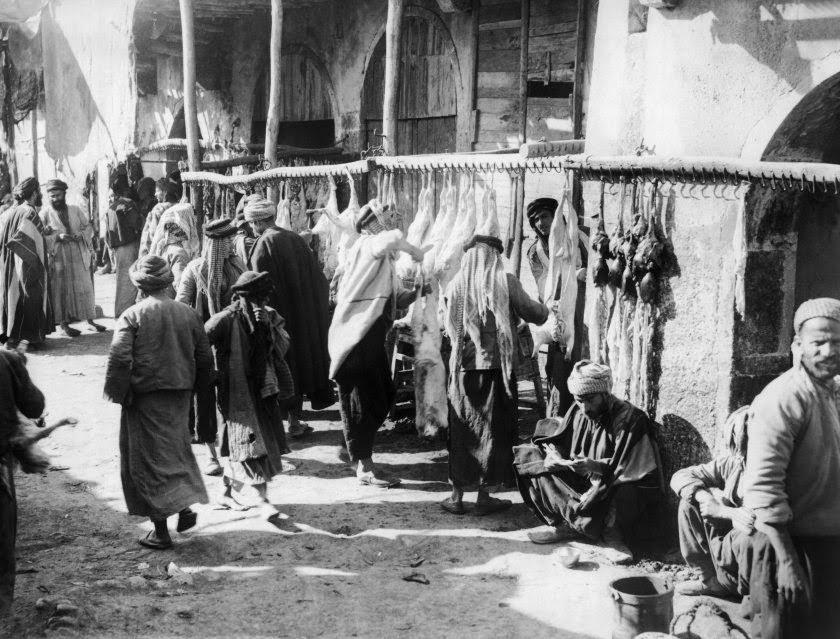
A meat market in Mosul, 1959.

Kirkuk, 1956
 I do recommend this article by Roqayah Chamseddine:
Jean Bricmont’s powerful book Humanitarian Imperialism: Using Human Rights to Sell War, written during the occupation of Iraq, is a timely historical critique of Western interventionism, one worth examining as the United States of America moves once more in the direction of military entanglement in Iraq. Bricmont, a Belgian theoretical physicist and professor at The Université catholique de Louvain, discusses the ideological factors which legitimize military action in response to humanitarian abuses and “in defense of democracy” (p. 7). — “This is the discourse and the representation that must be challenged in order to build a radical and self-confident opposition to current and future wars.” The humanitarian rationales offered under the banner of there being “a responsibility to protect” have only increased since the end of World War II, and methods to reinforce such motivations have grown progressively coercive.
Bricmont introduces a formula which will come to define “humanitarian imperialism:” when A exercises power over B, he does so for B's "own good" (p. 11). This is the creed of philanthropic power — which peddles and rationalizes war as a column maintaining international order — and which continues to define the very nature of international conflict post-World War II. Interventionism is no longer argued as being warranted in the name of Christianity, Bricmont argues, but what he calls ideological reinforcements: democracy and human rights. For example, despite former US President George W. Bush’s frequent use of religious imagery, the call to invade Iraq was not only drenched in chilling white saviourism but an overwhelming exceptionalism which contends that only military efforts led by the United States of America would bring about a just liberation and lasting stability for the people of Iraq. “[T]he dangers to our country and the world will be overcome. We will pass through this time of peril and carry on the work of peace,” George W. Bush stated in 2003. “We will defend our freedom. We will bring freedom to others and we will prevail.”

The horrors inflicted upon the people of Iraq are still understated, and since 2003 the bloodshed has not stopped. When Obama delivered his speech in 2011 celebrating the US military withdrawal, there were bombings and shootings in Baghdad, in Mosul, in Kirkuk and in Tal Afer. While the Iraqi people were preparing burial shrouds Obama was reaffirming the previous administration’s claims that the US left for the Iraqi people a stable country, had forged a lasting peace and made the world more secure. Amongst the congratulatory frill and repugnant nationalism Obama did make one salient point — that the US legacy in Iraq will endure and that it shall be remembered. The legacy of this tragic and implacable war will live on in the wombs of Iraqi women who bear children with congenital birth defects as a result of depleted uranium; the riddled bodies of those now suffering from cancer due to the toxic munitions used by the US military and finally in the land of Iraq, which has been devoured and polluted by the chemical weapons the US unleashed during its occupation.
 - Iraq intervention, redux? The folly of 'humanitarian imperialism.'


Sunday, 15 June 2014

Around the Coasts of Arabia

Here's a piece of vintage orientalism I came across while looking for sources on seafaring in the Indian Ocean in times past: an essay by Alan Villiers, author of Sons of Sindbad.  That latter book is his account of his voyage with an Arab trading dhow in 1938-39, with the north-east monsoon from the Gulf of Aden down the East African coast to Zanzibar and back to Oman, Bahrain, and Kuwait, where he spent some time with pearl divers.  I haven't tracked down a copy of this yet either; most of Villiers' books are out of print or very expensive and Not Available In My Region.  But the National Maritime Museum in Greenwich has put Villier's spectacular photographs from that trip and others online.  You can even buy prints.
  
Excerpted from 'Around the Coasts of Arabia,' published in the Marine Corps Gazette, May 1949:
Muscat, in Oman, is a port of importance in world steamship routes. It is on the regular mail route between Bombay and Basra, and the Indian government, under British rule, maintained a post and telegraph office there. Native craft generally used the smaller, more open port of Mutrah, immediately to the north of Muscat harbor.  
Muscat, Oman 1913 (source)
Badans at Mutrah. The larger of these typically Omani craft could make the voyage to East Africa, while the smaller ones were used for fishing.
Here there is the usual covered bazaar, and fish market most unhygienic - on the beach beneath the hot sun. Many of the inhabitants are Baluchi, from Baluchistan across the Gulf of Oman. At Mutrah bay I have seen some of the most primitive sailing-vessels still using the deep sea, some of them dating back, surely, to Phoenician days. Incredibly small and inefficient vessels sail from there down to Zanzibar, in the good season, and frequently also sail back again.

Becalmed off the Swahili coast (Alan Villiers)

Ready for auction, freshly caught tuna await buyers at Sur, Oman’s chief fishing center. From the 7th to the 19th centuries Sur was a hub for the slave trade that stretched from East Africa to India. (NatGeo)
Around the whole of the southern coasts of Arabia and in the Gulf of Oman, the good season is the northeast season. There are two annual monsoons, northeast and southwest. The northeast lasts from October to the middle of April or some time in May; the southwest blows during most of the rest of the year. From the beginning of November to the end of February, the northeast monsoon prevails as a steady moderate breeze with fine, settled clear weather and a smooth sea. These are the conditions which the dhows revel in, both coastwise and deepsea. It is not at all uncommon to find 50 in together at a place like Ma'alla. The area of greatest regularity in this northeast wind is to the eastward and southeastward of the island of Socotra. In March the winds are variable, and now the big dhows begin to come home from Zanzibar and across the Indian Ocean, for they do not like to be out in the southwest monsoon. The weather then is often thick, hot, and extremely unpleasant, and the wind may reach gale force with a nasty sea. The southwest season is no time for amphibious exercises. [...]
A boom under full sail often carried a jib to take full advantage of the wind, like this one probably off the south Arabian coast. (Alan Villiers)
A fine baggala, probably the 'Bedri' of Kuwait, having her hull cleaned, Kwale Island.
The most trying conditions for personnel travelling in the Red Sea are to be found aboard transports going either north or south, with the wind following them at the same speed as the ship, and insufficient or no air conditioning. These conditions cause heat prostration, for which the Red Sea is notorious. But ashore the climate is not so bad, especially if people learn quickly to gear their lives to the existing climatic conditions and not those they knew back home. The busiest time in the Arab day is from dawn to about 10:30 am. The Arab eats lightly at dawn, generally breakfasting on a little unleavened bread and some strong tea, heavily sweetened: at 10:30 he has his mid-morning meal, and does not eat again until the early evening. His robes are cool and comfortable; his house, though lacking in sanitation and almost always without even running water, is cool, and well ventilated. He sleeps in the open, whether he be Beduin or Sheikh. He wears his picturesque head-cloth so that he can wrap up his face against severe dust storms, and his head-ropes are to keep his headgear on. He has learned to live properly under the conditions of his country; it would be a good idea to study how he does it, if so be you ever get the opportunity.
Nejdi had come on ahead to the Hadhramaut coast to drum up custom for his boom. These prospective passengers were trekking to Mukalla from the hinterland.
While the Bedouin still herd camels and goats and move camp every three or four months to find forage, they no longer depend on them for subsistence. (NatGeo)
On the whole, though trying, the climate is by no means as bad as it is reported to be. Up in the mountains, of course, it is cool enough. The local Beduin have a curious belief that indigo dye will keep them warm. I have seen them coming down from the interior into the roads of Shihr with no clothing other than a brief, black sarong, long matted hair thick with ghee, and black indigo smeared heavily on their lithe and almost fleshless bodies, though they had come straight from the hills. [...]

Now that the age-old seclusion of much of Arabia is becoming a thing of the past, the standard of local government, and services, is improving almost everywhere. But there still are bad spots. On the coast near the Kuria Buria Islands, there are tribes of pirates who are still held in awe by date-laden dhows: in many parts of Oman, the locals would sooner take a pot shot at the stranger than hang out any flags. Policing much of South Arabia was from the air, mainly by the Royal Air Force; when a tribe of Beduin break the raiding rules with persistent carelessness, sometimes they must be bombed. But on the whole there is more peace now than there has been for many years, and the influx of wealth and western ideas is making for good government. [...]
 
HM Taimur bin Turki, Sultan of Oman, 1913 (source)

The typical Arab has two things which very greatly sustain him, no matter what he might otherwise lackand these things are his calm philosophical outlook, the growth of much contemplation in an existence very close to a harsh and unforgiving Nature; and his Moslem religion. To him, both these are very real things indeed. He may know little of mass production and his greatest industry may be concerned with the production of some indifferent tobacco or good coffee beans, or queerly flavored honey. He likes to rub some perfume on his forehead, in the evenings, and to waft the fumes of burning incense into his wide nostrils. He eats in silence, crouching and using the right hand only; womenfolk are neither present nor discussed: he is at home on a strip of rough carpet beneath the stars, or upon a camel's back, or seated cross-legged hour after hour in the stern sheets of a dhow. He may have slaves, concubines, vast possessions (some of the wealthiest property-holders in Singapore are Arabs, and in Java) ; or he may not have a change of indigo. He may trade in pearls or sheep from Berbera, dates from Basra, cotton-goods in the cheap bazaar at the Crater in rainless Aden. He may speak no language the average Westerner understands, though the business man is often at home in four or five difficult Eastern tongues. He may wear a dagger, carry an ancient rifle (not quite so out of date as it may appear), ride a racing camel, fondle his amber rosary.

A old man resting outside a shop in Muttrah Souq. (Times of Oman)
All these things he may well do; but one thing also you may depend upon. He will comport himself with quiet dignity like a man, and a man he is, and was, and always will be. A man's man, at home in a tough man's country. It is a country, too, where we can learn a lot.
I won't say much about 'quiet dignity.'  But I take it Villiers never saw men shouting at each other, sitting around talking and laughing.  Or he just forgot about it.  Confirmation bias and all.  That's a very narrow and Noble Savage view of Omani men.

The Sheikh of Kais, 1913 (source)
And Villers seems to have forgotten that Oman contains as many women as men. 

A picture from September 1955 showing women carrying waterpots in Muttrah with the office of the “Wali” in the background. (Andy in Oman)
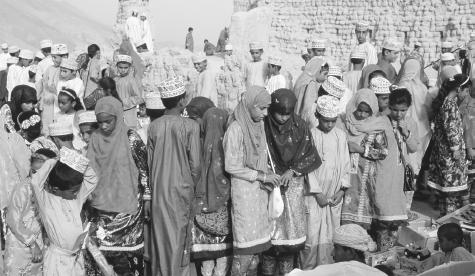
'A crowded market in Fanja' undated photo (Every Culture)
Women who live and work and give birth to children and raise them in what were and sometimes still are tough conditions.  He must have encountered women at some point; they were around doing things, but it strikes me how much he and Thesiger and other European travellers considered Oman and the Arabian Peninsula masculine countries inhabited by very masculine men, and rarely mention women or their contributions.  It's not just that women were frequently segregated and they mostly dealt with men, but also how endurance and going on trips involving hardship, especially in foreign lands, are gendered masculine and seen as things men do, and the experiences and contributions of other genders dismissed and discounted.

Most of the sources I found when I searched for "oman women in history" talked about how oppressed Omani women were/are by their culture, the need for Western organisations to liberate them, and the great strides they've made since Westernisation. It's all very colonial.  The introduction to the 'Women in Oman' Wikipedia article (the first hit for that search) pretty much sums up that narrative:
Women in Oman were historically excluded from the forums of everyday life. But with the dispersal of Omanis in the early 1900s and their return in the early 1970s, a more contemporary population of Omanis that were influenced by the British colonial values during their time abroad have slowly challenged many traditions of gender segregation. Women now pursue careers and professional training, slowly moving from their previous household confinement to the public sphere.[2] In Oman, 17 October is celebrated every year as the Omani Women's Day with various pro-female events.[3] (Wikipedia)
That whole article is terrible, and I do not recommend it.  It's written by people who fully believe in the development narrative - the modern form of the old colonial civilising mission; their rhetoric's just less obviously racist than it was in Kipling's time.  It's not that there weren't ever major problems in Omani society or aren't still, it's that Omani women are portrayed as victims of their backwards culture who need to be saved by the enlightened West.  Which is totally not misogynistic or exploiting the rest of the world for its own gain, nope.  The past was very different, and great changes have happened in the last forty years, but this narrative of Western influence liberating the world rather than local women and people around them working to change their own society from the inside while dealing with imperialist pressures and using foreign resources as they see fit is racist and ethnocentric, and covers up the real purposes of imperialist projects.

There was one result on the first page of Google result that talks about a few Omani women who were prominent in recorded history:

Indeed, the history of Oman also includes its share of women noted and recognized for their various contributions to public life.  To name a few, based on Al Balushi (2000), Seyyida Moza bint Al Imam Ahmad bin San Said was a top military strategist in the early eighteenth century, while Seyyida Khawla bint Seyyid Said bin Sultan, the daughter of the Sultan who ruled Oman from 1856 to 1857, was a known thinker, planner, and the most reliable member of the ruling family.  Shamsaa bint Al Alama Said bin Khalfan Al Khalili was a well-respected scholar and thinker in Islamic jurisprudence who was consulted to interpret some of the most difficult issues of the early nineteenth century.  Aisha bint Sheikh Issa Al Harthy was a famous poet of her time.  Al Ghalia bint Nasser bin Hmeid played a major role in national unity and social cohesion in Oman in the early 1900s.  The list is long and diverse, and continues from the noted late-nineteenth-century book author Seyyida Salma bint Sultan Al Seyyid Said bin Sultan to the more contemporary scholarly contributions of Nagiya bint Amer Al Hijriya, Sheikha bint Hilal Al Hinaiya, and Nasira bint Suroor Al Riyamiya, to mention only a few.

(Women in the Middle East and North Africa: Agents of Change,  by Fatima Sadiqi and Moha Ennaji, Routledge (2013) pg. 217 on Google Books)

I'm not going to do the research right now, but it's clear just from one source that there are many more, and countless other women who were not members of the ruling family or upper classes who lived ordinary lives and were never recorded.  But they were there, and they contributed. (I haven't read the whole book, but the section I quoted from is titled 'Omani women: the journey to empowerment'; it goes on to talk about outside influence empowering Omani women, which is also a pretty problematic narrative.  Empowerment in general is.  It can be hard to find sources in English on topics like this that aren't problematic to some degree.)

The world outside Europe was not only populated and participated in and at times ruled by local women as well as local men, it was explored and colonised and Christianised by Western women as well as Western men.  Women participated in imperialist exploration and mapping projects - quite a few of them.  There were a lot more than I realised before I went looking for lists.  Women were there, on both sides.  But they get left out of accounts, and left out of history.
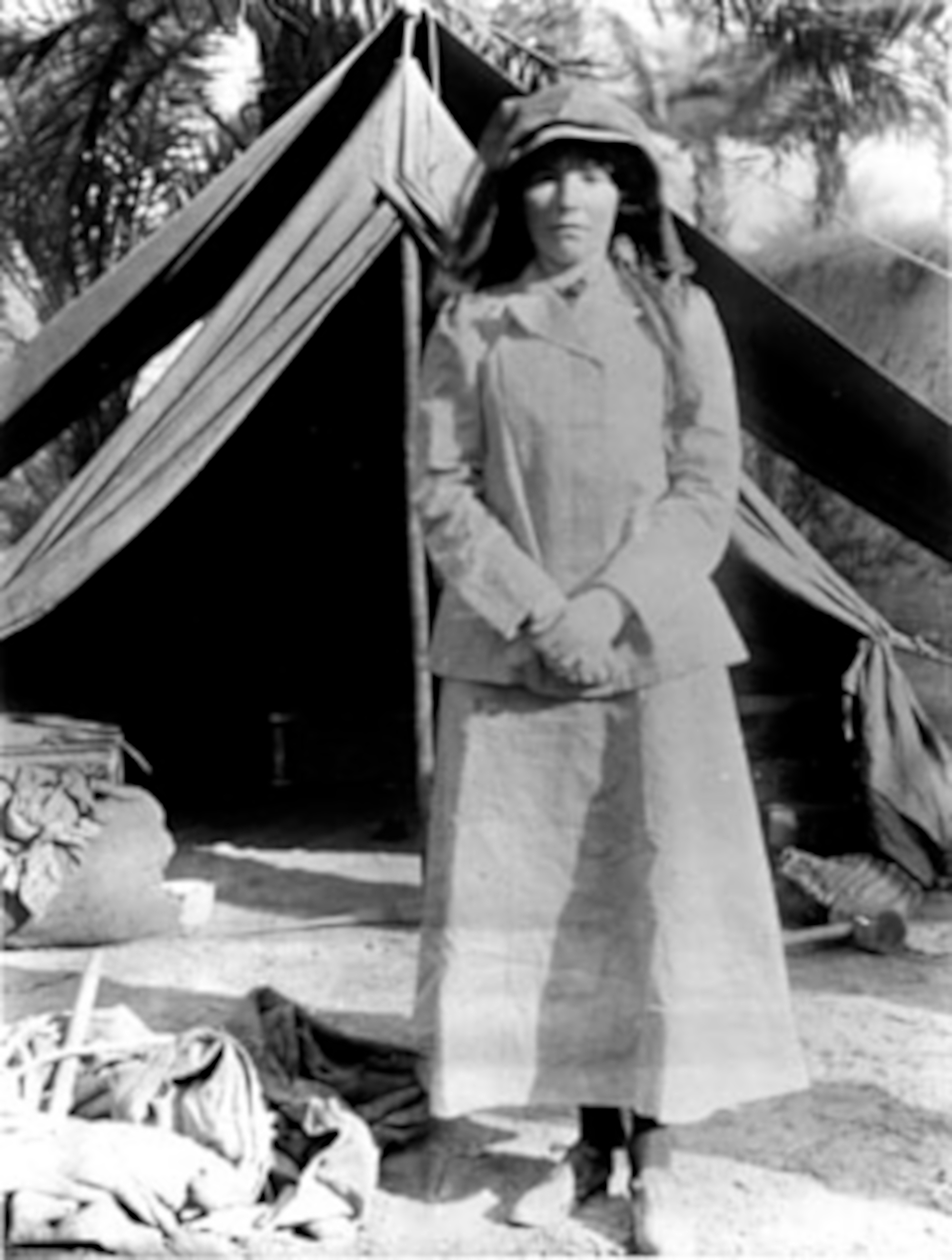
Explorer Gertrude Bell in Iraq in 1909 (Wikipedia).  She explored and mapped parts of Greater Syria, Mesopotamia, Asia Minor, Arabia, and wrote about her travels.
Here's a long list of Western female travellers and explorers of the 18th, 19th, and 20th centuries.  Here's another one.  Their imperialism and ethnocentrism and sense of superiority to other races weren't good things, but they were part of history and they should be included in history when we write about it.

Monday, 14 April 2014

Book Review: Memoirs of a Smuggler.


Memoirs of a Smuggler: Compiled from His Diary and JournalMemoirs of a Smuggler: Compiled from His Diary and Journal by John Rattenbury
(J. Harvey, London, 1837).

aMy rating: 3 of 5 stars

The ebook is available for free from Google Books (PDF or epub; the epub has a few scanning errors) or from Smugglers' Britain (html, proofread).

This is Jack Rattenbury's account of his exploits as a smuggler, mainly between France and the Devon coast, in the late 18th and early 19th century.  According to this website, a Unitarian pastor, John Smith (who was also involved in smuggling) helped him write it.

Born in 1778, Rattenbury went to sea as a fisherman at the age of nine, but soon left and took up as a privateer by the age of 15. From that point on, he was constantly pursuing and being pursued by French and Spanish vessels, and made many daring escapes - or so he tells us.

Returning home from privateering at the age of 16, Rattenbury says he
...remained at home about six months, part of which was occupied in fishing, but I found the employment very dull and tiresome after the roving life I had led; and as the smuggling trade was then plied very briskly in the neighbourhood, I determined to try my fortune in it" (pg. 11).
Rattenbury spent the next thirty years alternately smuggling, fishing, piloting, and running a public house which ultimately failed. His account is mostly a fairly dry recitation of the trips he made, places he went, and ships and cargoes he lost, but there are dramatic bits when he's chased by the preventive services and has to toss his tubs of spirits or tea overboard and hope to haul them up later, before the king's cutters or local inhabitants do and before they spoil.

Some of his anecdotes seem exaggerated for effect, as when he tells how he deserted from the Royal Navy and, in between smuggling trips, a militia sergeant found him in a pub and tried to capture him.
...in answer to his charge, I replied, “Sergeant, you are surely labouring under an error; I have done nothing that can authorize you in taking me up, or detaining me; you must certainly have mistaken me for some other person.” In this manner, I contrived to draw him into a parley; and, while it was going on, I jumped into the cellar. I then threw off my jacket and shirt, to prevent any one from holding me; and, having armed myself with a reaphook, and a knife which I had in my pocket, I threw myself into an attitude of defence at the entrance, which was a half-hatch door, the lower part of which I shut, and then declared that I would kill the first man who came near me, and that I would not be taken from the spot alive. At this, the sergeant was evidently terrified, but he said to his men, “Soldiers, do your duty, advance and seize him;” to which they replied, “Sergeant, you proposed it: take the lead, and set us an example, and we will follow.” No one, however, offered to advance, and I remained in the position which I have described, for four hours, holding them at bay (pg. 52).

A group of women then came into the pub and claimed that a boy was drowning, and Rattenbury claims that he charged through the militiamen, and because he had taken off his shirt, they couldn't catch him and he was able to jump into a boat and escape. A tall tale if I ever heard one.

At least once, Rattenbury smuggles people, in this case, four French officers who escaped from custody in England:
They came to Beer, and I concealed them in the best manner I was able, in a house near the beach, where I supplied them with such provisions as they wanted. But a vigilant inquiry was commenced; their steps were traced, and the place of their retreat discovered. The next morning, there was a special warrant out against myself and five others, who were connected with the affair, and the constables came to my house, while I was up-stairs considering how I had best act. Finding that my companions had absconded, and being captain of the boat, I immediately surrendered myself up to them. I was then taken before the magistrates, where I found the French gentlemen in custody. They were examined through the medium of an interpreter, but their replies were cautious, and they said very little that could tend to implicate me in the transaction. My turn then came; and, in reply to the questions from the bench, I briefly stated that I was engaged to take the gentlemen to Jersey, of which island I understood that they were natives. A lieutenant of the sea-fencibles being in the room, asked me if I did not know a native of Jersey from a Frenchman; to which I was going to have replied, but my attorney, who was present, said that this was a question which he had no right to prefer, and which I was not bound to answer. The magistrates then conversed together; and, after a little consultation, dismissed me, with a gentle admonition to go home, and not engage in any similar transaction for the future (pg. 51).
Rattenbury and his sons and gang of smugglers (he doesn't go into any detail in the narrative, but you can read about them here) are frequently on the wrong side of the law. Rattenbury repeatedly escapes the preventives and press-gangs and service in the Royal Navy, but he is in and out of court, is fined numerous times, and does a few stretches in prison. But no sooner is he released than he returns to smuggling and recoups his losses. Despite the frequent ups and downs of his career, it's clear that Rattenbury is a resilient and optimistic man:
I have also experienced, as may be seen in the foregoing narrative, the greatest vicissitudes, my spirits having been alternately elated by success, or depressed by misfortune; but in the midst of the whole I never yielded to despair, for hope was the pole-star which shed its cheering rays, and illuminated my path in the darkest storms of adversity (pg. 106).
When the book closes in 1836, Rattenburg is retired from smuggling, receiving a pension of a shilling a week for life from his patron Lord Rolle, and in court again.  His son, also a smuggler, is up on charges of assaulting customs officers, and Rattenburg is making jokes on the stand:
On this occasion I was cross-examined by Mr. Sergeant Bompas; and as it caused a great deal of amusement at the time, I have extracted the following passages from a newspaper, which contained an account of the trial. “I keep school at sea—fish for sole, turbot and brill; any kind of fish that comes to hook.” “Which do you catch oftenest, soles or tubs? “—” Oh, the devil a tub, (great laughter ;) there are too many picaroons going now-a-day.” You have caught a good many in your time? “—” Ah, plenty of it! I wish you and I had as much of it as we could drink.” (laughter.) “You have kept school at home, and trained up your son?”—” I have always trained him up in a regular honourable way, larnt him the creed, the Lord’s prayer, and the ten commandments.” “You don’t find there, Thou shalt not smuggle? “—” No, but I find there, Thou shall not bear false witness against thy neighbour.” “Nobody smuggles now-a-day?” — “Don’t they, though!” (laughter) “So these horses at Beer cannot go above three or four miles an hour? “—” If you had not better horses, you would never get to London. I seldom ride a horse-back. If I do, I generally falls off seven or eight times in a journey.” (great laughter.)
Jack Rattenbury died in 1844 at the age of 65.

There is very little description of the methods of smuggling or political situation in this book; to understand fully what was going on, I recommend reading it along with Smugglers' Britain, which details how smuggling and the preventive services worked, and how they developed.

I found King's Cutters and Smugglers: 1700-1855 (E.K. Chatterton, London, 1912) helpful as well.  It's written in a more engaging style than Memoirs of a Smuggler and explains the background to it.  For example, King's Cutters states that it was policy for the Preventives to press-gang smugglers into the Royal Navy, due to their high level of seamanship:
Nor must we forget that those rough, rude men who ran backwards and forwards across the English Channel in cutters, yawls, luggers, and sometimes open boats, stiffened with a rich ballast of tea, tobacco, and brandy, were some of the finest seamen in the world, and certainly the most skilful fore-and-aft sailors and efficient pilots to be found anywhere on the seas which wash the coasts of the United Kingdom. They were sturdy and strong of body, courageous and enterprising of nature, who had "used" the sea all their lives. Consequently the English Government wisely determined that in all cases of an encounter with smugglers the first aim of the Preventive officers should be to capture the smugglers themselves, for they could be promptly impressed into the service of the Navy and be put to the good of the nation instead of being to the latter's disadvantage.
(Although, I'm puzzling over who constitutes the "nation."  Have smugglers been excluded from it?  Their efforts were to their own benefit and the benefit of probably the majority of the inhabitants of the British Isles in some fashion, while not being without detriment.  All sorts of people of all classes were involved in smuggling and bought smuggled products).