Tuesday, 24 November 2015

Rosehip November

I woke up at 10.30 am a few days ago (November 20th) and looked outside while I was putting the kettle on. Everything the sun hadn't yet touched (most things at that time of day) was white with frost.

The grass was stiff and crunchy underfoot.  My toes immediately began to freeze inside my boots. Jesse crouched under the porch going "uuurrrrhh" ("what the hell is this") while I took photos of geranium and buttercup leaves covered in ice crystals. Eventually I got far enough away that he followed me out onto the grass, but he wasn't happy about it.


I've held onto these photos for a while, and I don't know what to say about them. I'm just barely hanging on these days. I don't know what to say about anything. There are no words, for some things.

I haven't seen frost in nearly a decade, and I don't have any memory from before of what it was like, or what anything else here was like. It's entirely new to me now. This is not where I wanted to end up, or what I wanted to be doing, but the frost is pretty cool. And I like the rosehips.


The sun on the fields in the afternoon.


Jesse sleeping on my lap while I read and following me around outdoors.


A decaying old snag at the edge of the field that finally succumbed to the wind last week, and fell into a thicket of roses laden with fruit.


A friend showed me this song today:

Rose hip November 
Autumn I'll remember 
Gold landing at our door 
Catch one leaf and fortune will surround you evermore 
Evermore, evermore

Vashti Bunyan (Youtube)

Saturday, 21 November 2015

Reconstructing an early medieval turf house in the Netherlands

This is a time lapse video showing the reconstruction of an 8th century turf farmhouse at the Yeb Hettinga Museum in the village of Firdgum, Friesland, northern Netherlands:


The finished house in November 2015:

(University of Groningen/medievalists.net)

 Firdgum had a population of 100 in 2004, according to Wikipedia, and is located in the fertile salt marshes along the coast of northern Friesland.   

Location of Friesland in the Netherlands (in red).  (Wikipedia)

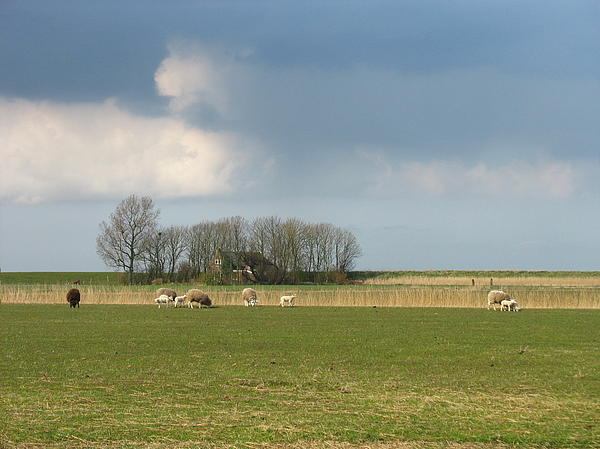
Landscape in Friesland with sheep (source).
 
Horses in a salt marsh in Lauwersmeer, Friesland (source).

In the days before dykes, regular flooding prevented trees from growing in the north of the Netherlands, so very little wood was available to build houses.  Starting around 400 AD, houses there were built on artificial platforms to keep them out of the flood water, and constructed  of stacked clay turf blocks (turves). The walls of this house are a metre thick, which both insulates the house from the cold of the North Sea coast and supports the weight of the roof. 

Most of the 8th century house collapsed due to a roof leak in 2013 and was reconstructed starting in 2014 by volunteers, in coordination with the University of Groningen. 

The collapsed house, from a article dated November 2013 (Photo by Jakob Talsma)

 
You can see the exposed rafters of the turf house here.  I'm guessing that's the museum building behind it, but I haven't been able to translate 'Yeb Hettinga Skoalle.'  That might be in Frisian, not Dutch. (Photo by Daniel Postma)

The pre-collapse roof, replaced in the summer of 2013, was made of layers of sod and manure over wooden rafters, but the roof of the 2015 reconstruction is made of thatch over wooden rafters.  I don't know why that might be.

The 2014-2015 reconstruction project was part of Daniël Postma’s PhD research into building traditions in the northern coastal regions of the Netherlands.  Postma published a book, Het zodenhuis van Firdgum – Middeleeuwse boerderijbouw in het Friese kustgebied tussen 400 en 1300 (”The Firdgum sod house: Medieval farmhouse building in the Frisian coastal area between 400 and 1300″) which details the design and construction process of the turf house.  (Description of the book translated by Google).

The medievalists.net article on the reconstruction describes the house:
The [farm house], which is nearly 17 metres long, is characterized by a 1 metre-thick carrier wall made of layered turf, as was customary throughout the region from the fifth to the early eighth century. It is also the first archaeological reconstruction with an arch-shaped roof construction, which clearly distinguishes it from the rectangular trusses of existing historic farmhouses.

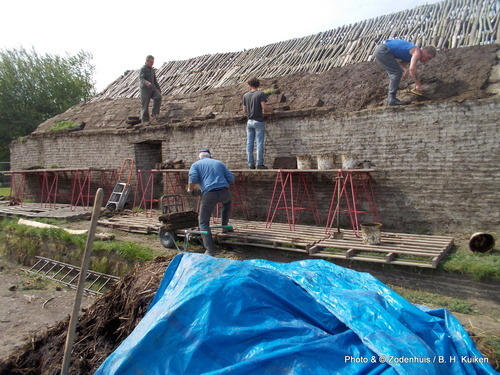
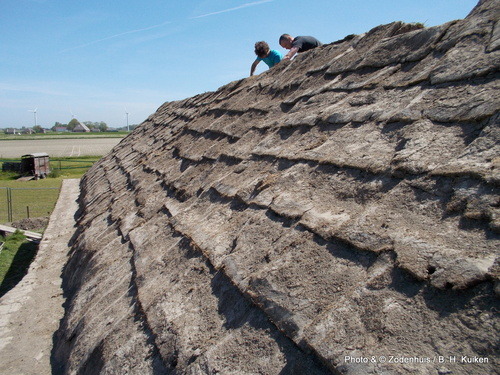
I couldn't find more than a couple progress photos of the reconstruction, just the video up top and a few casual photos on the Zodenhuis Project Twitter (mostly in Dutch), but I did find some good quality photos of a roof replacement done on the house in the summer of 2013 on the Zodenhuis Project Tumblr (in Dutch):

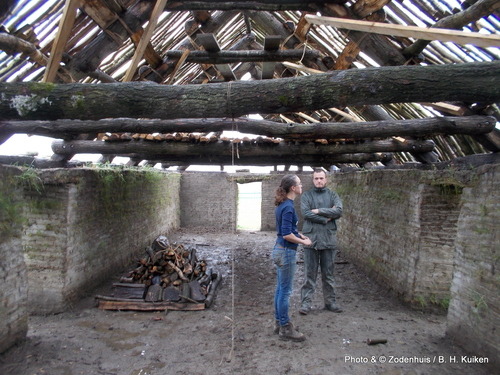
The stripped inside of the house (May 2013)
 
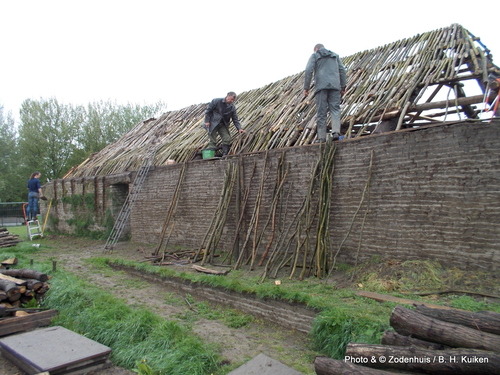
The rafters almost ready to be covered with sod (May 2013)


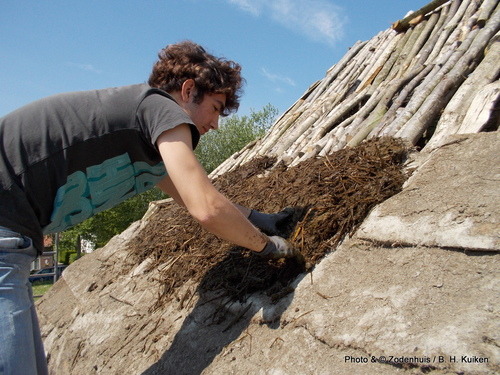
Applying cow manure mixed with straw over top of the turves to provide a waterproof layer (May 2013)


Manure being applied to the first layer of sod (May 2013)


"On the west side the roof of the sod house is now equipped with the first layer of turf. This side now awaits a layer of manure and two layers of sod." (June 2013)


The house after it re-opened to the public later in 2013:

The finished house.  I think those dots are cow patties stuck to the walls to dry.

That little girl is even wearing wooden clogs.  I'm guessing that's early medieval dress (Yeb Hettinga Museum).


Inside the house (Zodenhuis Project, fall 2013)


A pot of something cooking over an open fire inside (Yeb Hettinga Museum).
Houses in prehistoric and early medieval Europe didn't have chimneys, so the smoke from the fire either drifted out through the door, if it was open, or just filtered out through the roof, like this thatched example in Ireland:

From Aidan O'Sullivan on Twitter.
There's a bit more on early medieval Frisian turf houses and this house's construction at Daniel Postma's Tumblr, the  Zodenhuis Firdham Facebook page (in Dutch) and Twitter (mostly in Dutch), the Zodenhuis Project Tumblr (inactive, in Dutch), but I've summarised most of it here. I found a couple academic articles in the links section of the project Tumblr, but I can't read Dutch and that's more than Google Translate can handle.

Thursday, 22 October 2015

Weeds; or, The Secret Garden

My grandma died about ten years ago, and there's very little left in her garden besides grass and plants that are considered weeds. I was startled when I came back to Canada, because I had been looking forward to seeing it again, and it was nothing like I remembered.  Only the empty beds were left. One more piece of her had disappeared while I wasn't looking.


This is Geranium molle, native to the Mediterranean and now a lush carpet covering filling what used to be the lawn around our raised vegetable beds.  The grass is pretty much gone. I didn't really notice it before the leaves started to turn red, but I think it's rather pretty. There's some buttercups in there too, and also a Galium species (cleavers or bedstraw), I can't tell which. It doesn't quite look like G. aparine but I looked through a lot of botanical literature and I can't find any closer species. It may or may not be native to North America, but it is edible in small quantities (large quantities have a mild laxative effect).

My grandma had a bed of a cultivated Galium species, sweet woodruff, next to the front walk, but it's almost entirely gone now. What little is left probably won't last much longer.

What plants are weeds and what are proper plants seems to be a matter of opinion, and of desire for the plant, and of frustration with it. Especially if it's introduced. Most of the plants left in my grandma's garden are foreign, and considered noxious or invasive weeds, undesirable - but then, the prettier plants that she cultivated and loved were introduced too. They just weren't resilient enough or suitable enough for this climate to survive after she was gone.

Rather a lot of the plants left in the garden turn out to be edible. There's also tall amaranth, and broadleaf dock, whose leaves are developing reddish spots like rust:


Dock leaves can be cooked and eaten in small quantities (large quantities can be hazardous, since they contain oxalic acid), and the leaves were described being used to wrap blocks of fresh butter in Adam Bede. The seeds can be ground and eaten, but they contain a lot of chaff and there's no way to remove it.

There's sow thistle, related to dandelion, old and bitter at this time of year but edible when the leaves are young:


There's Himalayan blackberry everywhere, of course:


It produces a fair bit of fruit on second-year canes, and I'm told the leaves can be made into tea, although I haven't tried it yet.

 Morning glory is everywhere:


It's not edible, and it strangles everything, but at least the flowers are pretty. The burdock had pretty purple flowers earlier, but they've been replaced by brown burrs:


Probably the most striking thing in the garden at this time of year is the rose bush. Its hips are edible too, and can be made into tea:


It's so huge and vigorous and exceptionally thorny that I suspect a more tender rose was grafted to it and didn't survive, especially since it's right next to the fence where my grandma had roses planted. I didn't notice what sort of flowers it had this spring or summer.

 If Mary Lennox's secret garden were real, this is what it would look like after a decade left mostly to itself. The wildest of the roses would have survived and run rampant, and the crocuses and daffodils naturalised, but most of the cultivated plants would have disappeared and the small weedy ones that slipped in unwanted volunteered to take their places, and flourished, a carpet of green in the spring, dotted with white and yellow flowers in the summer, seed heads turning brown in the fall and leaves shading to yellow, touched with red, dotted with rust, fading to brown and falling crumpled to the ground.  The plants lie dormant all winter, but finally the roots and stems spring to life again in March, as they do every year without fail.

---
For two or three minutes [Dickon] stood looking round him, while Mary watched him, and then he began to walk about softly, even more lightly than Mary had walked the first time she had found herself inside the four walls. His eyes seemed to be taking in everything—the gray trees with the gray creepers climbing over them and hanging from their branches, the tangle on the walls and among the grass, the evergreen alcoves with the stone seats and tall flower urns standing in them.

"I never thought I'd see this place," he said at last, in a whisper.

"Did you know about it?" asked Mary.

She had spoken aloud and he made a sign to her.

"We must talk low," he said, "or some one'll hear us an' wonder what's to do in here."

"Oh! I forgot!" said Mary, feeling frightened and putting her hand quickly against her mouth. "Did you know about the garden?" she asked again when she had recovered herself. Dickon nodded.

"Martha told me there was one as no one ever went inside," he answered. "Us used to wonder what it was like."

He stopped and looked round at the lovely gray tangle about him, and his round eyes looked queerly happy.

"Eh! the nests as'll be here come springtime," he said. "It'd be th' safest nestin' place in England. No one never comin' near an' tangles o' trees an' roses to build in. I wonder all th' birds on th' moor don't build here."

Mistress Mary put her hand on his arm again without knowing it.

"Will there be roses?" she whispered. "Can you tell? I thought perhaps they were all dead."

"Eh! No! Not them—not all of 'em!" he answered. "Look here!"

He stepped over to the nearest tree—an old, old one with gray lichen all over its bark, but upholding a curtain of tangled sprays and branches. He took a thick knife out of his Pocket and opened one of its blades.

"There's lots o' dead wood as ought to be cut out," he said. "An' there's a lot o' old wood, but it made some new last year. This here's a new bit," and he touched a shoot which looked brownish green instead of hard, dry gray. Mary touched it herself in an eager, reverent way.

"That one?" she said. "Is that one quite alive quite?"

Dickon curved his wide smiling mouth.

"It's as wick as you or me," he said; and Mary remembered that Martha had told her that "wick" meant "alive" or "lively."

"I'm glad it's wick!" she cried out in her whisper. "I want them all to be wick. Let us go round the garden and count how many wick ones there are."

She quite panted with eagerness, and Dickon was as eager as she was. They went from tree to tree and from bush to bush. Dickon carried his knife in his hand and showed her things which she thought wonderful.

"They've run wild," he said, "but th' strongest ones has fair thrived on it. The delicatest ones has died out, but th' others has growed an' growed, an' spread an' spread, till they's a wonder. See here!" and he pulled down a thick gray, dry-looking branch. "A body might think this was dead wood, but I don't believe it is—down to th' root. I'll cut it low down an' see."

He knelt and with his knife cut the lifeless-looking branch through, not far above the earth.

"There!" he said exultantly. "I told thee so. There's green in that wood yet. Look at it."

Mary was down on her knees before he spoke, gazing with all her might.

"When it looks a bit greenish an' juicy like that, it's wick," he explained. "When th' inside is dry an' breaks easy, like this here piece I've cut off, it's done for. There's a big root here as all this live wood sprung out of, an' if th' old wood's cut off an' it's dug round, and took care of there'll be—" he stopped and lifted his face to look up at the climbing and hanging sprays above him—"there'll be a fountain o' roses here this summer."
 - Frances Hodgson Burnett, The Secret Garden, Chapter XI, 'The Nest of the Missel Thrush,' pg 128-9.
The illustrated 1911 edition of The Secret Garden is available on the Internet Archive.

Saturday, 17 October 2015

Why lizards are your friend and Italian peasants love garlic, according to Erasmus

I came across an interesting bit of folklore today.  The Dutch Renaissance writer Erasmus of Rotterdam  (1466-1536) reported in his Colloquies that snakes in Italy love milk, hate garlic, and will crawl down your throat while you’re sleeping and take up residence in your stomach, but lizards are friendly to humans and will warn you about them.  It's an origin myth explaining why peasants love garlic and snakes and lizards are enemies, but I don't know if its origins are in actual folk belief, or if it's a different sort of popular story.  Or some combination of the two.  I can't find any other source for those snippets of story, but Erasmus did study in Italy so it's possible that belief existed there at one time. 

From The Whole Familiar Colloquies of Desiderius Erasmus of Rotterdam, translated by Nathan Bailey, 1877, pg. 388-9, Concerning Friendship: Ephorinus and John.’

Ep. Do you know the lizard?
Jo. Why not?
Ep. There are very large green ones in Italy.  This creature is by nature friendly to mankind, and an utter enemy to serpents. […]
The husbandmen of that place related to us a wonderful strange thing for a certain truth; that the countrymen being weary sometimes, sleep in that field, and have sometimes with them a pitcher of milk, which serves both for victuals and drink; that serpents are great lovers of milk, and so it often happens that they come in their way.  But they have a remedy for that. 

Jo. Pray, what is it?
Ep. They daub the brims of the pitcher with garlic, and the smell of that drives away the serpents.
Jo. What does Horace mean, then, when he says garlic is a poison more hurtful than henbane, when you say it is an antidote against poison?
Ep. But hear a little, I have something to tell you that is worse than that.  They often creep slily into the mouth of a man that lies sleeping with his mouth open, and so wind themselves into his stomach.  

Jo. And does not a man die immediately that has entertained such a guest?
Ep. No, but lives most miserably; nor is there any remedy but to feed the man with milk, and other things that the serpent loves.  

Jo. What, no remedy against such a calamity?
Ep. Yes, to eat an abundance of garlic.
Jo. No wonder, then, mowers love garlic.
Ep. But those that are tired with heat and labour have their remedy another way; for, when they are in danger of this misfortune, very often a lizard, though but a little creature, saves a man.
Jo. How can he save him?
Ep. When he perceives a serpent lying perdue in wait for the man, he runs about upon the man’s neck and face, and never gives over till he has waked the man by tickling him, and clawing him gently with his nails; and as soon as the man wakes, and sees the lizard near him, he knows the enemy is somewhere not far off in ambuscade, and looking about seizes him.
Jo. The wonderful power of nature!
 Wonderful indeed.

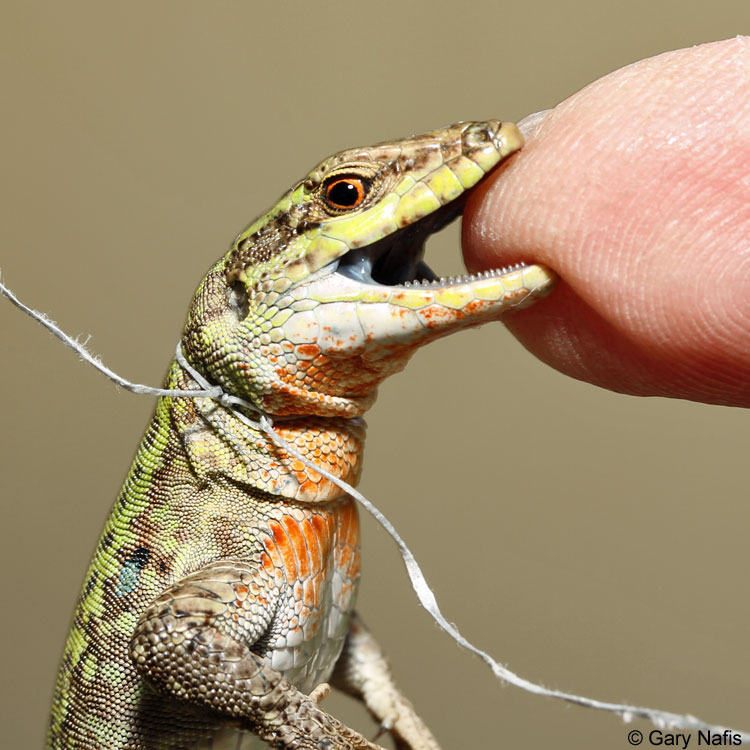
The largest Italian lizard species I can find is the Italian wall lizard, Podarcus sicula - which is also the most abundant lizard species in Italy. They're up to 3.5 inches (9cm) long, so not very large.

Podarcis sicula on a dry branch near Urbino in Tuscany (Florian Prischl/Wikimedia Commons).

Podarcis sicula found in Los Angeles county.  They're very adaptable and have been introduced to part of the US and North Africa (California Herps).

 Erasmus was an interesting guy who lead a busy life; he was the illegitimate child of a priest and a woman who was possibly his housekeeper who lost his parents to the plague and was pressed into monasticism by poverty.  He later left the monastery to become a secretary, and was permanently released from his vows by the Pope, which was unusual.  He was ordained as a Catholic priest at the age of 25, although he doesn't seem to have worked as one much.  He studied at the University of Paris on a stipend and then the University of Turin and became a classical scholar and prominent Christian Humanist thinker and popular writer.

A 1523 portrait of Erasmus by Hans Holbein the Younger, who painted him several times (Wikimedia).

 He was a professor at Cambridge at one point and complained about the lack of wine:

At the University of Cambridge, he was the Lady Margaret's Professor of Divinity and had the option of spending the rest of his life as an English professor. He stayed at Queens' College, Cambridge from 1510 to 1515.  His rooms were in the "I" staircase of Old Court, and he famously hated English ale and English weather. He suffered from poor health and complained that Queens' could not supply him with enough decent wine (wine was the Renaissance medicine for gallstones, from which Erasmus suffered). Until the 19th century, Queens' College used to have a corkscrew that was purported to be "Erasmus' corkscrew" which was a third of a metre long, though today the college still has what it calls "Erasmus' chair." (Wikipedia)
In the early sixteenth century, Erasmus produced a critical edition of the New Testament, including the late Greek texts and facing them a more polished Latin translation and his own notes, saying "It is only fair that Paul should address the Romans in somewhat better Latin."[32]

Later editions of his New Testament were used by Martin Luther as a basis for his German translation, and probably also by Tyndale for the first English New Testament and by Stephanus for the English version that the translators of the King James Version based their text on.

By the 1530s, the writings of Erasmus accounted for 10 to 20 percent of all book sales in Europe.[63]

He died suddenly from dysentery in Basel, Switzerland in 1536. 

A little bit about his Colloquies, from Wikipedia:
Colloquies is one of the many works of the “Prince of Christian Humanists”, Desiderius Erasmus. Published in 1518, the pages “…held up contemporary religious practices for examination in a more serious but still pervasively ironic tone”. […]
The Colloquies is a collection of dialogues on a wide variety of subjects. They began in the late 1490s as informal Latin exercises for Erasmus’ own pupils. In about 1522 he began to perceive the possibilities this form might hold for continuing his campaign for the gradual enlightenment and reform of all Christendom. Between that date and 1533 twelve new editions appeared, each larger and more serious than the last, until eventually some fifty individual colloquies were included ranging over such varied subjects as war, travel, religion, sleep, beggars, funerals, and literature. All of these works were in the same graceful, easy style and gentle humor that made them continually sought as schoolboy exercises and light reading for generations.
 They are humorous, and very entertaining.  I've downloaded that pdf from Google Books and will probably read more of it, unless I forget.

Friday, 16 October 2015

Harvest 2015: too much zucchini, and cranberry ginger ale

A few days after the harvest moon (September 27th this year, I think), my brother and cousin carried huge zucchini into the house in armloads like firewood. We had six zucchini plants, and that never seems like too many when you're seeding them, but more than one or two zucchini plants is really Too Much Zucchini.  He gave me a smaller one (it's like six inches thick and two feet long) and some cherry tomatoes, and I have no idea what I'm going to do with it.  I don't really eat much these days.  My mom suggested I carve the zucchini like a jack 'o lantern, which they used to do when they couldn't afford to buy pumpkins.

Left: a sink full of pickling cukes that turned into little blimps.  Right: a row of zucchini, and in front of them a row of Long English cucumbers.
 My cousin spent his day off peeling the sink full of pickling cukes so he could slice them and make basically every sliced pickle recipe he could come up with.  They got big enough that the skins were too tough to leave on.  His mom came over and helped him for a while.  I would have helped too, but I didn't know it was happening until it was already finished, because I went to bed at 6am.

He intends to mix the Long English cucumbers and zucchini together and grate them and make yellow relish, and chocolate zucchini cake, and soup, and anything else he can think of.  I made zucchini marmalade one year.  I think they have a food processor up there, but he's still going to be grating and canning and bagging (you can freeze grated zucchini in flat ziploc bags) for a long time.


Long English cucumbers that got too big and yellow.  I didn't even realise we had that many in there.

We tried the Long English cucumbers that went yellow, and I was expecting them to be bitter and inedible, but they were actually alright.  My cousin said they tasted sort of like watermelon, and my brother said they tasted like the watermelon rind (they were pretty hard), and I told them about pickling watermelon rind with the green skin cut off when I was a teenager.  I used to pickle anything that would hold still long enough, because not having anything to eat was a real fear.  I don't know how I found the energy to do all that, but it's probably still in the cellar that nobody goes into because it's extremely creepy and the light doesn't work.  My mom and grandmother and p much every female relative I have known do the same thing; my mom has an amazing amount of fish in the freezer and discount dried pasta in the cupboards.  We still have stacks of plastic yoghurt containers and ice-cream buckets my grandmother saved, and pickles and canned fruit she made in the nineties that nobody knows what to do with.  We might need it someday.  She's been gone nearly a decade.

(They ended up throwing most of the old yellow cucumbers out, though.  We're not hungry enough for it to be worth the work of canning all those).

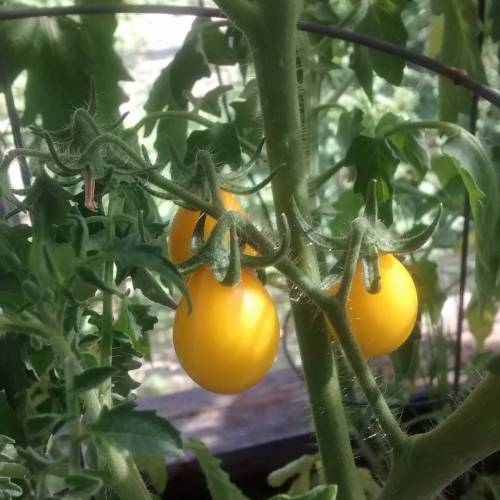
Yellow pear tomatoes in late August.
Grape tomatoes in early August.

 None of the pics I took of the tomatoes we picked in bowls worked out, but I got some of the greenhouse a week or so before they were picked.


The tomatoes on September 17, just after I revived them.  The plants were a lot yellower and more bare than they look here.

They're in one-gallon pots and it's around 30C in the greenhouse at that time of year, so the tomatoes have to be watered a couple times a day.  I was too sick to leave the house for a while, and when I eventually went out into the garden, the tomatoes were completely limp and nearly dead.  I was really puzzled, because the guys had been watering them all year (and I'd been doing it occasionally), so why would they stop right before they finally produced some fruit?

I asked my cousin, and he said that they just got tired of having to water the damn things all the time on top of going to work etc.  If I'd known, I might have gone out sooner, but  I don't talk to them often.

I watered the tomatoes and kept watering them, and broke all the old dead leaves and extra suckers off, and they perked up pretty well.  I really didn't expect them to survive, but the fruit that was already half-ripe did end up ripening.  The green fruit was completely shrivelled and the flowers died, so I don't think we'll be getting any more tomatoes this year.  We only got a few handfuls, and like twelve partially-eaten apples.  It was not a good year for anything but zucchini and cucumber.

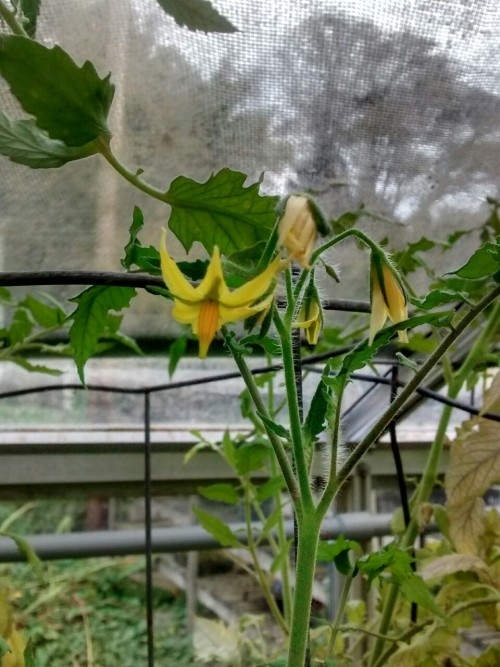
(Update:  Actually, it's October 16th now, and the tomato plants have new flowers, so we might get a few more tomatoes.)


 Unfortunately, watering the tomatoes after a period of drought made a lot of the fruit split.

They're still edible.

Cucumber flowers in early August.
Pickling cukes and zucchini at the end of August.  That's a 4" pot for scale.

Zucchini in late August.  As soon as it rained the plants were covered in mildew, so that's it for them.
Mildewed zucchini plants on September 17.  They'd had a chance to grow some since the rain.  It's now a month later, and they're definitely toast.

 Artist Ursula Vernon created the little-known anthropomorphic Saint Wombus:

St. Wombus, a little known saint of the late middle ages, achieved fame and beatification for what came to be known as the Miracle of the Zucchini.

Namely, there was only ever the ONE zucchini.

This feat, a sort of vegetable inversion of the loaves and fishes, was so astonishing and obviously counter to nature that Wombus was beatified at once.

His blessing is sought by gardeners who have foolishly overplanted. An icon of St. Wombus, buried upside down in the vegetable patch, is believed to keep most members of the squash family at manageable levels.

(Image and description from Red Wombat Studios)
 
(An anthropomorphic Christian saint is really not that far-fetched; see cynocephaly.  Some saints were popularly depicted with the heads of dogs in Russian Orthodox traditions, especially St. Christopher).

When my cousin brought me down an armload of vegetables, he threw a frozen salmon steak he had caught and packaged on top because they have way too much fish in the freezer. And then they all sat on the porch in the evening sun drinking cranberry Canada Dry ginger ale mixed with vodka. It was extremely Canadian.

Mixing cranberry Canada Dry with vodka and some fruit (blackberries or raspberries in summer) and ice in a large glass or mason jar is really popular (the guys upstairs go for the mason jar), but the soda itself is pretty much the official special occasion drink of children and people who don't drink in Canada.  As far as I can remember, we only had it at birthday dinners and Christmas when I was a kid, so it was pretty fancy.

From a whole Pinterest board of stereotypically Canadian foods.  It's kind of embarrassing how accurate it is.
The soda is a reddish-pink colour, like the can.  The colour is 98% of the appeal; I don't remember it tasting any different from regular ginger ale.

If you look up recipes for non-alcoholic drinks made with cranberry Canada Dry, you'll find them mostly on mom blogs and food blogs.  They have some fantastic photography of very pretty drinks, but I won't use it without permission. 

(Putting cranberries in Christmas drinks made with cranberry gingerale is popular in online recipes, but nobody actually likes eating raw cranberries and they're kind of a pain to drink around, so another sort of berry is probably a better bet.)


Sunday, 4 October 2015

Book Review: Farm Rhymes


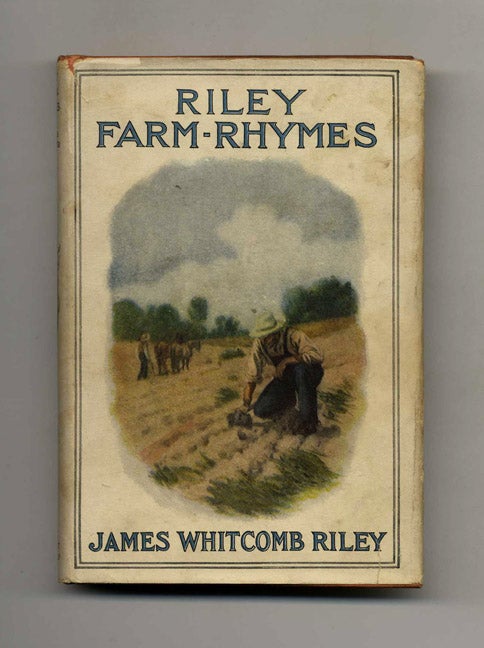
This 1905 edition is selling for $140, but you can get the ebook free (source).
Verdict: enjoyable, three out of five stars.

American poet James Whitcomb Riley (1849-1916) had only an eighth-grade education (he graduated when he was twenty), but he was a successful newspaper reporter and a very popular poet in the 1880s and 1890s.  Farm Rhymes was first published in 1888 and the poems are quite Victorian and sentimental, but I think this collection holds up better for modern adult readers than Riley's children's poems or humorous poems do, although the latter two were more popular in his lifetime.

Farm Rhymes is a short collection of simple poems about rural life, written in either Indiana dialect (I didn't find it hard to understand, and I'm not American) or standard late nineteenth century American English. Topics include harvest, fishing, family, nostalgia for childhood, and descriptions of nature - birds and woods especially. There are black and white illustrations for each poem; only a third of the pages have text on them, and there's not a lot of text on each page. 

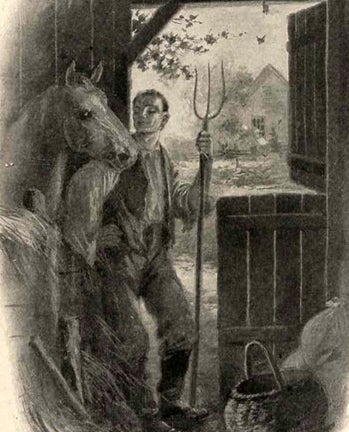
One of the illustrations.

 I read this book in about an hour one morning, it's really very short. My favourite poem out of the collection is 'When the frost is on the punkin.' It's fairly widely published on the internet, and seasonally appropriate.

When the frost is on the punkin and the fodder's in the shock
And you hear the kyouck and gobble of the struttin' turkey cock
And the clackin' of the guineys, and the cluckin' of the hens
And the rooster's hallylooyer as he tiptoes on the fence
O, it's then's the times a feller is a-feelin' at his best
With the risin' sun to greet him from a night of peaceful rest
As he leaves the house, bareheaded, and goes out to feed the stock
When the frost is on the punkin and the fodder's in the shock

They's something kindo' harty-like about the atmusfere
When the heat of summer's over and the coolin' fall is here
Of course we miss the flowers, and the blossums on the trees
And the mumble of the hummin'-birds and buzzin' of the bees
But the air's so appetizin'; and the landscape through the haze
Of a crisp and sunny morning of the airly autumn days
Is a pictur' that no painter has the colorin' to mock
When the frost is on the punkin and the fodder's in the shock.

The husky, rusty russel of the tossels of the corn,
And the raspin' of the tangled leaves, as golden as the morn;
The stubble in the furries kindo' lonesome-like, but still
A-preachin' sermuns to us of the barns they growed to fill;
The strawstack in the medder, and the reaper in the shed;
The hosses in theyr stalls below the clover over-head!
O, it sets my hart a-clickin' like the tickin' of a clock,
When the frost is on the punkin and the fodder's in the shock!

Then your apples all is gethered, and the ones a feller keeps
Is poured around the celler-floor in red and yeller heaps;
And your cider-makin' 's over, and your wimmern-folks is through
With their mince and apple butter, and theyr souse and saussage, too!
I don't know how to tell it but ef sich a thing could be
As the Angels wantin' boardin', and they'd call around on me
I'd want to 'commodate 'em all the whole-indurin' flock
When the frost is on the punkin and the fodder's in the shock!
A scan of the 1901 edition of Farm Rhymes is available for free on the Internet Archive. The epub doesn't preserve the line breaks and the scanning program garbled the dialect beyond comprehension, so I read the PDF.  More of Riley's works are available for free on Project Gutenberg.