Showing posts with label garden. Show all posts

Thursday, 22 October 2015

Weeds; or, The Secret Garden

My grandma died about ten years ago, and there's very little left in her garden besides grass and plants that are considered weeds. I was startled when I came back to Canada, because I had been looking forward to seeing it again, and it was nothing like I remembered.  Only the empty beds were left. One more piece of her had disappeared while I wasn't looking.


This is Geranium molle, native to the Mediterranean and now a lush carpet covering filling what used to be the lawn around our raised vegetable beds.  The grass is pretty much gone. I didn't really notice it before the leaves started to turn red, but I think it's rather pretty. There's some buttercups in there too, and also a Galium species (cleavers or bedstraw), I can't tell which. It doesn't quite look like G. aparine but I looked through a lot of botanical literature and I can't find any closer species. It may or may not be native to North America, but it is edible in small quantities (large quantities have a mild laxative effect).

My grandma had a bed of a cultivated Galium species, sweet woodruff, next to the front walk, but it's almost entirely gone now. What little is left probably won't last much longer.

What plants are weeds and what are proper plants seems to be a matter of opinion, and of desire for the plant, and of frustration with it. Especially if it's introduced. Most of the plants left in my grandma's garden are foreign, and considered noxious or invasive weeds, undesirable - but then, the prettier plants that she cultivated and loved were introduced too. They just weren't resilient enough or suitable enough for this climate to survive after she was gone.

Rather a lot of the plants left in the garden turn out to be edible. There's also tall amaranth, and broadleaf dock, whose leaves are developing reddish spots like rust:


Dock leaves can be cooked and eaten in small quantities (large quantities can be hazardous, since they contain oxalic acid), and the leaves were described being used to wrap blocks of fresh butter in Adam Bede. The seeds can be ground and eaten, but they contain a lot of chaff and there's no way to remove it.

There's sow thistle, related to dandelion, old and bitter at this time of year but edible when the leaves are young:


There's Himalayan blackberry everywhere, of course:


It produces a fair bit of fruit on second-year canes, and I'm told the leaves can be made into tea, although I haven't tried it yet.

 Morning glory is everywhere:


It's not edible, and it strangles everything, but at least the flowers are pretty. The burdock had pretty purple flowers earlier, but they've been replaced by brown burrs:


Probably the most striking thing in the garden at this time of year is the rose bush. Its hips are edible too, and can be made into tea:


It's so huge and vigorous and exceptionally thorny that I suspect a more tender rose was grafted to it and didn't survive, especially since it's right next to the fence where my grandma had roses planted. I didn't notice what sort of flowers it had this spring or summer.

 If Mary Lennox's secret garden were real, this is what it would look like after a decade left mostly to itself. The wildest of the roses would have survived and run rampant, and the crocuses and daffodils naturalised, but most of the cultivated plants would have disappeared and the small weedy ones that slipped in unwanted volunteered to take their places, and flourished, a carpet of green in the spring, dotted with white and yellow flowers in the summer, seed heads turning brown in the fall and leaves shading to yellow, touched with red, dotted with rust, fading to brown and falling crumpled to the ground.  The plants lie dormant all winter, but finally the roots and stems spring to life again in March, as they do every year without fail.

---
For two or three minutes [Dickon] stood looking round him, while Mary watched him, and then he began to walk about softly, even more lightly than Mary had walked the first time she had found herself inside the four walls. His eyes seemed to be taking in everything—the gray trees with the gray creepers climbing over them and hanging from their branches, the tangle on the walls and among the grass, the evergreen alcoves with the stone seats and tall flower urns standing in them.

"I never thought I'd see this place," he said at last, in a whisper.

"Did you know about it?" asked Mary.

She had spoken aloud and he made a sign to her.

"We must talk low," he said, "or some one'll hear us an' wonder what's to do in here."

"Oh! I forgot!" said Mary, feeling frightened and putting her hand quickly against her mouth. "Did you know about the garden?" she asked again when she had recovered herself. Dickon nodded.

"Martha told me there was one as no one ever went inside," he answered. "Us used to wonder what it was like."

He stopped and looked round at the lovely gray tangle about him, and his round eyes looked queerly happy.

"Eh! the nests as'll be here come springtime," he said. "It'd be th' safest nestin' place in England. No one never comin' near an' tangles o' trees an' roses to build in. I wonder all th' birds on th' moor don't build here."

Mistress Mary put her hand on his arm again without knowing it.

"Will there be roses?" she whispered. "Can you tell? I thought perhaps they were all dead."

"Eh! No! Not them—not all of 'em!" he answered. "Look here!"

He stepped over to the nearest tree—an old, old one with gray lichen all over its bark, but upholding a curtain of tangled sprays and branches. He took a thick knife out of his Pocket and opened one of its blades.

"There's lots o' dead wood as ought to be cut out," he said. "An' there's a lot o' old wood, but it made some new last year. This here's a new bit," and he touched a shoot which looked brownish green instead of hard, dry gray. Mary touched it herself in an eager, reverent way.

"That one?" she said. "Is that one quite alive quite?"

Dickon curved his wide smiling mouth.

"It's as wick as you or me," he said; and Mary remembered that Martha had told her that "wick" meant "alive" or "lively."

"I'm glad it's wick!" she cried out in her whisper. "I want them all to be wick. Let us go round the garden and count how many wick ones there are."

She quite panted with eagerness, and Dickon was as eager as she was. They went from tree to tree and from bush to bush. Dickon carried his knife in his hand and showed her things which she thought wonderful.

"They've run wild," he said, "but th' strongest ones has fair thrived on it. The delicatest ones has died out, but th' others has growed an' growed, an' spread an' spread, till they's a wonder. See here!" and he pulled down a thick gray, dry-looking branch. "A body might think this was dead wood, but I don't believe it is—down to th' root. I'll cut it low down an' see."

He knelt and with his knife cut the lifeless-looking branch through, not far above the earth.

"There!" he said exultantly. "I told thee so. There's green in that wood yet. Look at it."

Mary was down on her knees before he spoke, gazing with all her might.

"When it looks a bit greenish an' juicy like that, it's wick," he explained. "When th' inside is dry an' breaks easy, like this here piece I've cut off, it's done for. There's a big root here as all this live wood sprung out of, an' if th' old wood's cut off an' it's dug round, and took care of there'll be—" he stopped and lifted his face to look up at the climbing and hanging sprays above him—"there'll be a fountain o' roses here this summer."
 - Frances Hodgson Burnett, The Secret Garden, Chapter XI, 'The Nest of the Missel Thrush,' pg 128-9.
The illustrated 1911 edition of The Secret Garden is available on the Internet Archive.

Friday, 16 October 2015

Harvest 2015: too much zucchini, and cranberry ginger ale

A few days after the harvest moon (September 27th this year, I think), my brother and cousin carried huge zucchini into the house in armloads like firewood. We had six zucchini plants, and that never seems like too many when you're seeding them, but more than one or two zucchini plants is really Too Much Zucchini.  He gave me a smaller one (it's like six inches thick and two feet long) and some cherry tomatoes, and I have no idea what I'm going to do with it.  I don't really eat much these days.  My mom suggested I carve the zucchini like a jack 'o lantern, which they used to do when they couldn't afford to buy pumpkins.

Left: a sink full of pickling cukes that turned into little blimps.  Right: a row of zucchini, and in front of them a row of Long English cucumbers.
 My cousin spent his day off peeling the sink full of pickling cukes so he could slice them and make basically every sliced pickle recipe he could come up with.  They got big enough that the skins were too tough to leave on.  His mom came over and helped him for a while.  I would have helped too, but I didn't know it was happening until it was already finished, because I went to bed at 6am.

He intends to mix the Long English cucumbers and zucchini together and grate them and make yellow relish, and chocolate zucchini cake, and soup, and anything else he can think of.  I made zucchini marmalade one year.  I think they have a food processor up there, but he's still going to be grating and canning and bagging (you can freeze grated zucchini in flat ziploc bags) for a long time.


Long English cucumbers that got too big and yellow.  I didn't even realise we had that many in there.

We tried the Long English cucumbers that went yellow, and I was expecting them to be bitter and inedible, but they were actually alright.  My cousin said they tasted sort of like watermelon, and my brother said they tasted like the watermelon rind (they were pretty hard), and I told them about pickling watermelon rind with the green skin cut off when I was a teenager.  I used to pickle anything that would hold still long enough, because not having anything to eat was a real fear.  I don't know how I found the energy to do all that, but it's probably still in the cellar that nobody goes into because it's extremely creepy and the light doesn't work.  My mom and grandmother and p much every female relative I have known do the same thing; my mom has an amazing amount of fish in the freezer and discount dried pasta in the cupboards.  We still have stacks of plastic yoghurt containers and ice-cream buckets my grandmother saved, and pickles and canned fruit she made in the nineties that nobody knows what to do with.  We might need it someday.  She's been gone nearly a decade.

(They ended up throwing most of the old yellow cucumbers out, though.  We're not hungry enough for it to be worth the work of canning all those).

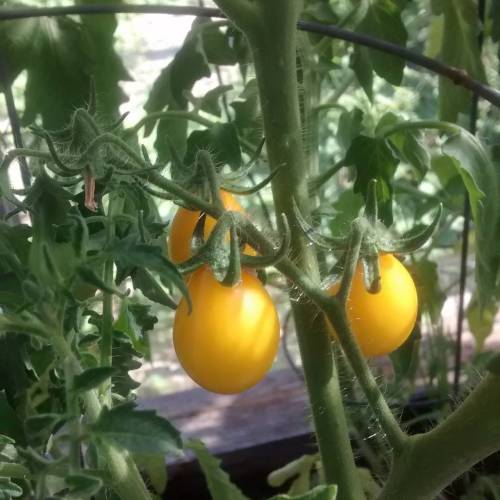
Yellow pear tomatoes in late August.
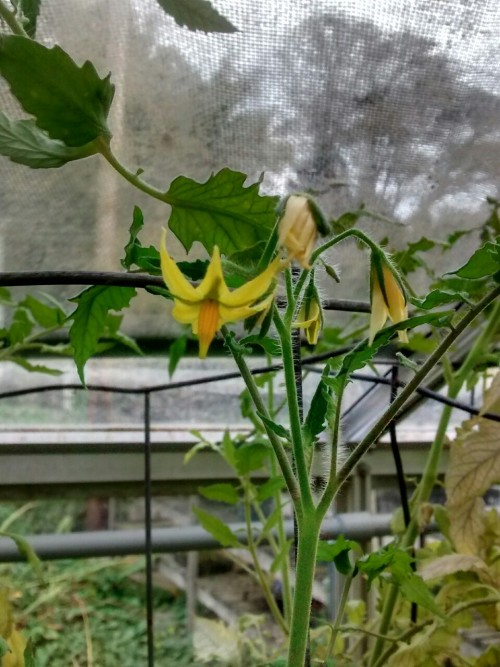
Grape tomatoes in early August.

 None of the pics I took of the tomatoes we picked in bowls worked out, but I got some of the greenhouse a week or so before they were picked.


The tomatoes on September 17, just after I revived them.  The plants were a lot yellower and more bare than they look here.

They're in one-gallon pots and it's around 30C in the greenhouse at that time of year, so the tomatoes have to be watered a couple times a day.  I was too sick to leave the house for a while, and when I eventually went out into the garden, the tomatoes were completely limp and nearly dead.  I was really puzzled, because the guys had been watering them all year (and I'd been doing it occasionally), so why would they stop right before they finally produced some fruit?

I asked my cousin, and he said that they just got tired of having to water the damn things all the time on top of going to work etc.  If I'd known, I might have gone out sooner, but  I don't talk to them often.

I watered the tomatoes and kept watering them, and broke all the old dead leaves and extra suckers off, and they perked up pretty well.  I really didn't expect them to survive, but the fruit that was already half-ripe did end up ripening.  The green fruit was completely shrivelled and the flowers died, so I don't think we'll be getting any more tomatoes this year.  We only got a few handfuls, and like twelve partially-eaten apples.  It was not a good year for anything but zucchini and cucumber.

(Update:  Actually, it's October 16th now, and the tomato plants have new flowers, so we might get a few more tomatoes.)


 Unfortunately, watering the tomatoes after a period of drought made a lot of the fruit split.

They're still edible.

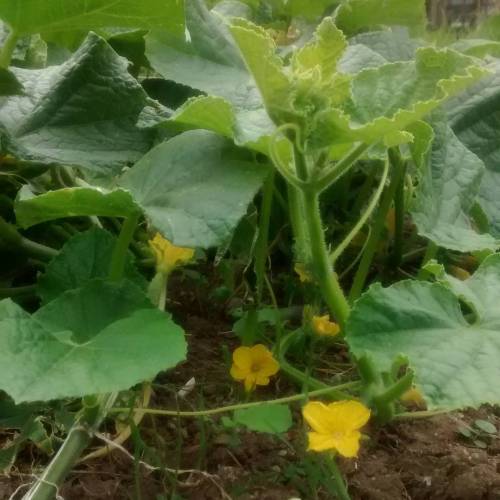
Cucumber flowers in early August.
Pickling cukes and zucchini at the end of August.  That's a 4" pot for scale.

Zucchini in late August.  As soon as it rained the plants were covered in mildew, so that's it for them.
Mildewed zucchini plants on September 17.  They'd had a chance to grow some since the rain.  It's now a month later, and they're definitely toast.

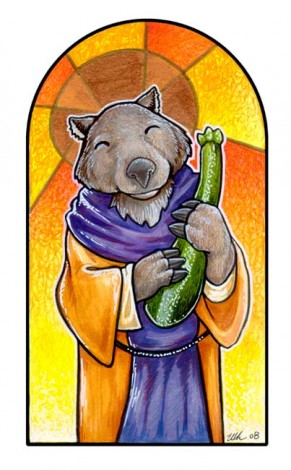
 Artist Ursula Vernon created the little-known anthropomorphic Saint Wombus:

St. Wombus, a little known saint of the late middle ages, achieved fame and beatification for what came to be known as the Miracle of the Zucchini.

Namely, there was only ever the ONE zucchini.

This feat, a sort of vegetable inversion of the loaves and fishes, was so astonishing and obviously counter to nature that Wombus was beatified at once.

His blessing is sought by gardeners who have foolishly overplanted. An icon of St. Wombus, buried upside down in the vegetable patch, is believed to keep most members of the squash family at manageable levels.

(Image and description from Red Wombat Studios)
 
(An anthropomorphic Christian saint is really not that far-fetched; see cynocephaly.  Some saints were popularly depicted with the heads of dogs in Russian Orthodox traditions, especially St. Christopher).

When my cousin brought me down an armload of vegetables, he threw a frozen salmon steak he had caught and packaged on top because they have way too much fish in the freezer. And then they all sat on the porch in the evening sun drinking cranberry Canada Dry ginger ale mixed with vodka. It was extremely Canadian.

Mixing cranberry Canada Dry with vodka and some fruit (blackberries or raspberries in summer) and ice in a large glass or mason jar is really popular (the guys upstairs go for the mason jar), but the soda itself is pretty much the official special occasion drink of children and people who don't drink in Canada.  As far as I can remember, we only had it at birthday dinners and Christmas when I was a kid, so it was pretty fancy.

From a whole Pinterest board of stereotypically Canadian foods.  It's kind of embarrassing how accurate it is.
The soda is a reddish-pink colour, like the can.  The colour is 98% of the appeal; I don't remember it tasting any different from regular ginger ale.

If you look up recipes for non-alcoholic drinks made with cranberry Canada Dry, you'll find them mostly on mom blogs and food blogs.  They have some fantastic photography of very pretty drinks, but I won't use it without permission. 

(Putting cranberries in Christmas drinks made with cranberry gingerale is popular in online recipes, but nobody actually likes eating raw cranberries and they're kind of a pain to drink around, so another sort of berry is probably a better bet.)


Sunday, 27 September 2015

Neighbourhood fruit banditry and a supermoon

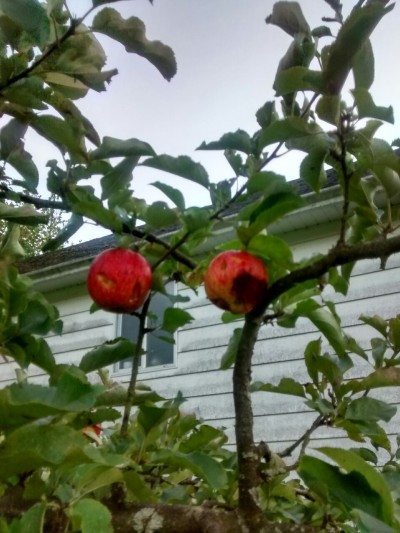
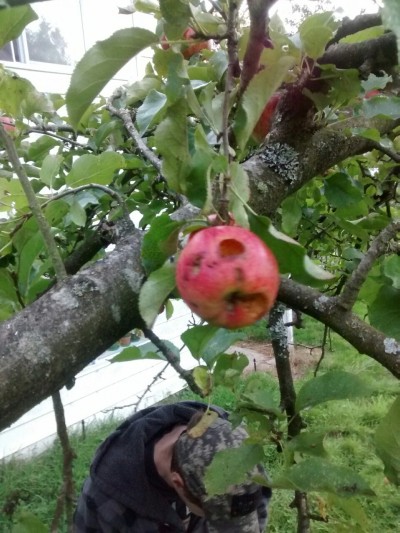
We picked the last of the apples on the bear tree this evening, before the crows could peck holes in the rest of them. (Jesse helped by crouching under the porch watching and yowling at me to come pet him. I obliged. He’s currently sprawled on my lap purring while I pet him with one hand and type  with my other hand).

Every time my brother opened the upstairs window, a huge flock of crows took flight from the tree; the sound of deer chomping on apples in the middle of the night was creeping out his girlfriend; and the fruit was attracting bears. My brother saw a bear wander around the yard and then climb the poor tree again. They're eventually going to totally break it.

The crows sit in the tree and peck at the apples.  They got pretty much all of them, but they're still edible.
My brother had to pick most of the apples, me and his girlfriend are both too short.
I thought the guys had borrowed a ladder and picked the other trees last month, but it turns out the next door neighbour called my brother and asked if he could come over with his kids and pick some fruit. My brother went out the next day, and all four full sized apple and pear trees and the old crabapple tree were completely stripped, the neighbour must have gotten a 30 foot fruit picking ladder from somewhere and spent a lot of time at it. He even picked up every single windfall from the ground and took them, too. Rude.

What is he even going to do with all that fruit? Maybe he’s extremely fond of applesauce, I have no idea. We're not even mad, that's the sort of thing the guy does. Too bad about all that fruit though, we were looking forward to that.

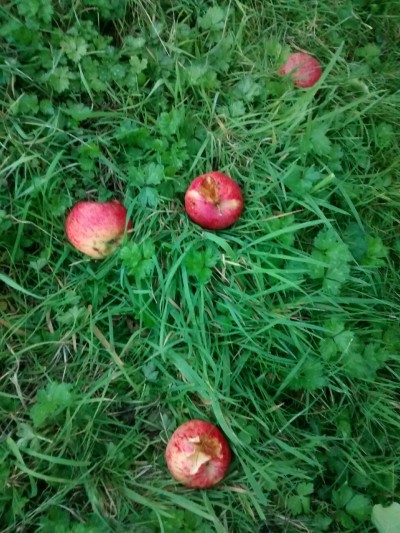
The tree after we picked it.  We left some apples on the ground for the deer.  That furry black blob on the right hand edge under the porch is Jesse.


So the only fruit we got this year was the few crow-pecked apples from the bear tree that the wildlife didn’t completely eat. My brother and his girlfriend are going to cut them up and make a crumble. She’s trying to convince him that it’ll be fine without butter or much sugar, but he’s not buying it.

The apples on September 16th, untouched by crows.  We should have picked them then.  Oh well.
Tonight was the harvest moon and also a combination supermoon (when the moon is full and at its closest point to the earth, so it appears much larger than usual), and lunar eclipse, which colours the moon red.  (Watch the NASA video explaining it).  That coincidence hasn't happened since 1982, and won't happen again until 2033.  But we are as far west as it gets, so the moon didn't make it over the horizon before the eclipse ended, much less over the trees.  That's okay though, I have seen supermoons and lunar eclipses before, and there are lots of great photos of the event on the internet.

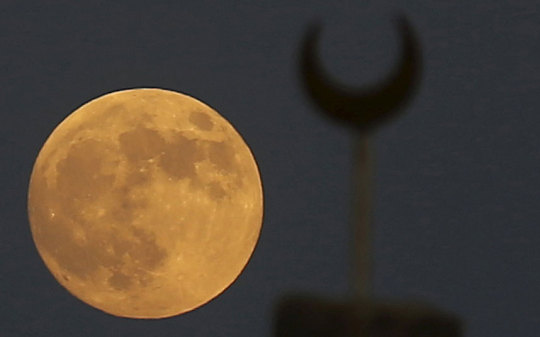
A flock of birds fly by as the supermoon rises in Mir, Belarus, 95 kilometers west of capital Minsk (Telegraph)
I imagine the moon would have looked like this in Canada. It was a clear, sunny day today and there were a lot of birds flying around.


The supermoon rises near the minaret of a mosque in Wadi El-Rayan Lake in Fayoum Governorate, southwest of Cairo (Sources: O Globo; Telegraph).
Muslims see eclipses as a reminder of the Day of Judgement, when the sun, moon, and stars will all lose their light.

  فَإِذَا بَرِقَ الْبَصَرُ ﴿٧ وَخَسَفَ الْقَمَرُ ﴿٨ وَجُمِعَ الشَّمْسُ وَالْقَمَرُ ﴿٩ يَقُولُ الْإِنسَانُ يَوْمَئِذٍ أَيْنَ الْمَفَرُّ

So when vision is dazzled, and the moon darkens, and the sun and moon are joined together: Man will say on that Day, "Where is the [place of] escape?" (Al-Qiyamah 75:7-10)


 The pre-Islamic Arabs believed that celestial bodies had power over events and people's fates, and sometimes worshipped them or associated them with their gods, but this is not part of Islamic belief.
  
  وَمِنْ آياتِهِ اللَّيْلُ وَالنَّهارُ وَالشَّمْسُ وَالْقَمَرُ لا تَسْجُدُوا لِلشَّمْسِ وَلا لِلْقَمَرِ وَاسْجُدُوا لِلَّهِ الَّذِي خَلَقَهُنَّ إِنْ كُنْتُمْ إِيَّاهُ تَعْبُدُونَ

Among His signs are the night and the day and the sun and moon. Do not prostrate yourselves before the sun or the moon; rather prostrate yourselves before Allah, Who created them both, if you truly are His worshippers. (Fussilat 41:37)
On the day the Prophet Muhammad's infant son Ibrahim died in the year 10 AH/632 AD, there was a solar eclipse and people thought the sun was eclipsed in sadness over the death Ibrahim's death, but the Prophet said:

«إنَّ الشمسَ والقمرَ من آيات اللهِ، وإنهما لا يَنخسفان لموتِ أحدٍ ولا لحياتِه، فإذا رأيتُموهما فكبِّروا، وادعو اللهَ وصلُّوا وتصدَّقوا»
Sahih Muslim, narrated by A'ishah bint Abu Bakr, no. 901 (Wikipedia)

“The sun and the moon do not eclipse because of the death or life (i.e. birth) of someone. When you see the eclipse praise Allah, make dua and pray and give charity."

There was an eclipse when I was in college in Jordan, and the students in the dorm prayed salaat al-kusoof (the eclipse prayer) in congregation, although it can be prayed individually.

Salaat al-kusoof is two raka'at with long recitations of the Quran in each, prayed after a solar or lunar eclipse starts and lasting no longer than the eclipse does (although it doesn't have to be that long).  If it's a total eclipse, surat al-baqarah is often read in the first raka'ah.  There are a number of hadith describing how to pray it, including two well-known ones narrated by Aishah.  It's mostly considered a confirmed sunnah (instructions on how to pray it here).  The Imam ash-Shafi'i and two of the other four sunni imams (not Hanafi) recommend that a khutbah (sermon) be given after salaat al-kusoof, but at school or at home there was no one to give one.

(Sorry about the allcaps on that one Quran verse in English, I didn't mean to shout.  Some of the formatting is weird here, but I couldn't fix it.  Getting html to work when you're pasting in both English and Arabic quotes is such a pain, and my favourite Quran site no longer uses images of the verses in Arabic so I can't just put those in and avoid the formatting problems).

Tuesday, 4 August 2015

Garden: August 03 2015

I walked into town this morning to go to the bank and pay bills (I haven't payed my healthcare premium in four months, oops), but it was closed.  It turns out it's BC Day, a statutory holiday.  But I got a few things at the grocery store, and I took a few pictures along the way.

Angel wing begonias outside the grocery store.

Fuschias outside the grocery store.
 I believe that's Fuschia triphylla 'Gartenmeister Bonstedt,' which is bushy and upright but is not hardy.  Carl Bonstedt of the Gottingen Botanical Gardens in Germany introduced it along with a bunch of other cultivars in 1904-1905, and it's still very popular. (American Fuschia Society)


Above, some flowers growing along the side of the road.  On the left is rudbeckia, and I think the one on the right might be purple loosestrife (Lythrum salicaria), which is listed as a noxious weed in BC.


The blackberries are coming along.  I ate a bunch and they're actually sweet now.  Himalayan blackberry is also a noxious weed, but at least it produces something edible.

I was surprised when I came back, after nearly fifteen years away, and the gardens were gone and a thriving thicket of Himalayan blackberry and strapping alder trees in their place.  There's blackberry and morning glory up to the eaves, and in some places you can't see out the windows at all.  I've been back a few times over the years, but if I've looked at the gardens in that time I don't remember it.  It's like being in Sleeping Beauty's castle.

Our house is at the bottom of a hill just after the bend of a sharp corner.  There's a concrete barrier along most of the front yard, but there's a 15ft gap in it at the bend.  There's also a straight clear path between the road the the front right corner of the house.  It's perfectly placed for drunks who lose control on the corner to shoot through the front yard and hit the house, which happens frequently.  There used to be fruit trees between the road and the house, and there still are some around the side of the house, but over the years the drunk drivers have cleared a path to the house.

My brother was telling me that last time a drunk hit the house, he was too plastered to find his way out of the yard.  He drove all over the front lawn hitting trees and the concrete barrier.  There is another gap in the barrier next to the driveway that a vehicle can fit through, but it was dark and he was too drunk to find it.  While he's driving around, my brother calls the cops and gives a description of the truck and the driver, and then the guy gets out of the truck and staggers around, so my brother locks all the doors from the inside.  A while later, he saw flashing lights and went outside to meet the cops, and the door slammed and locked behind him, and he didn't have his keys or his wallet on him.

The cops saw a truck abandoned on the lawn and a tall youngish man standing in the yard looking at him, and they decided he was their suspect and would not listen when he said he lived there and he wasn't drunk and he didn't even have a driver's license.  They unzipped his hoodie, and he was wearing a red t-shirt underneath.  He had said the driver was wearing a red shirt, so that sealed it.  They arrested him and put him in the back of the police car while they went to investigate the truck.

Luckily our uncle came by from next door to see what the flashing lights were about, and saw my brother in the back of the cruiser.  The cops believed my uncle that my brother lived there and didn't drive, and they didn't charge him with anything.  I assume they found the driver eventually, since he was catastrophically drunk and had left his truck behind.  All that's left now is a huge dent in the siding on the front right corner of the house.


I'm almost certain I grew this cactus from seed in the sixth grade.  It's survived somehow, although it's barely been watered since my grandmother died eight years ago.

Sweet Cicely seedheads against the summer sky.
You can almost watch the zucchini plants grow.  That little zucchini wasn't there before the weekend, but it's already 4" long.


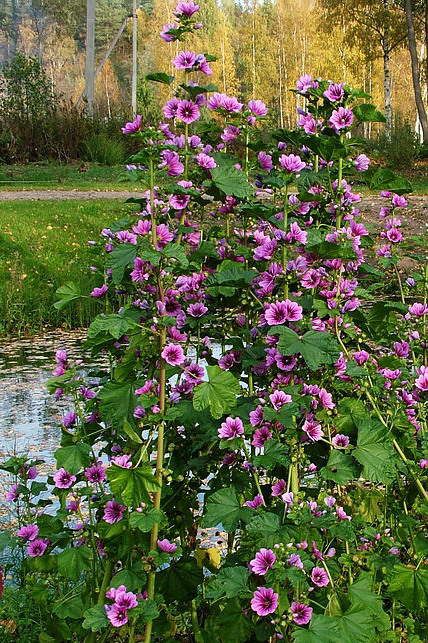
A rose mallow (Malva sylvestris 'zebrina') growing out of a crack in a concrete path.

Here's a bigger mallow plant growing in Russia.

It's a very old plant and an easy one to grow, technically a short-lived perennial, but ours only live a year.  They reseed themselves and grow back the next year without an any effort or attention.  They have a long flowering season, don't need a lot of water, and aren't invasive.  A good-sized bush will be about three feet tall and two wide.  My grandmother used to grow them, but the only ones left are growing in cracks in the pavement and not in the garden beds. 

Our cats: left, Gracie; right, Jesse.

Shortly after I took this picture, Gracie jumped off the couch and caught one of her claws in the afghan on the way down.  I was reading something and it took me a few moments to realise that she was flailing around on the floor in a panic.  Her paw was still stuck to the afghan sitting on the couch cushion.  I yanked the afghan off the couch and dropped it on the floor.  She freed herself and ran off.

Jesse used to only sit on my lap when he really wanted attention and I wasn't giving him any.  He would sit on my lap and lick my hand while I tried to type on my phone, until I stopped and pet him.  Then he would get off my lap and curl up against me on the couch.  Except last weekend, he curled up on my lap and wouldn't get off.  I moved him and got up and later sat back down again with my laptop on my lap, and he stood next to me on the couch and yowled at me until I put the laptop on the table and let him back on my lap.  And then I was stuck reading on my phone, because I couldn't have both the cat and the computer on my lap at once, and I couldn't reach the coffee table from the couch.

He was really clingy, and I thought maybe he was sick, but he was eating fine and behaving normally, just sitting on me a lot.  But this is the cat who wouldn't even come near me for four months, and then started wandering into my kitchen and demanding to be fed.  I think he just levelled up in trust again.  He's not on my lap all of the time anymore, he's beside me right now, but he still sleeps on me a lot.  I guess that's normal for cats, I'm just not used to it.

Monday, 3 August 2015

Garden: late July 2015

 (Another post I forgot in the drafts folder.  Oops).

Most of the trees in the orchard died years ago and were never replaced, but there's a few types of apples and pears left. The plums are all gone, sadly. We do have one younger plum tree, and for the first time ever it has half a dozen plums on it, but it's been there for 20 years and it's never had plums before.  It needs another tree to pollinate it.  Maybe someone else planted a suitable one?  We can hope.  And whatever it was grafted to is now a thorny bush the size of a truck, and sending up thorny suckers all over the backyard.  That tree was not a success.

Apples on the older tree.  They're fine for cooking or sauce, but they don't taste nearly as good as the apples on the bear tree.

The two pear trees are very old and the fruit isn't that good, but it's fine for juice or canning.

 The bear tree.

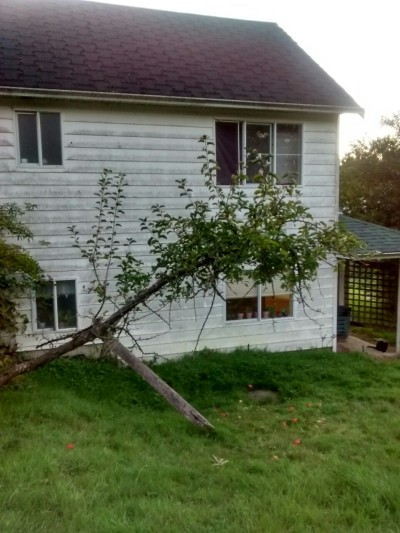
A bear tried to climb this small apple tree to get at the fruit a few years ago, so now it's propped up by a stick.  But it's still covered in apples, and my brother said they taste the best out of all the trees.


It was a hot day and the cows were all laying down.  The goldenrod is starting to flower.  I couldn't get any closer because there's a ditch in the way and the ditches here don't fool around.  The ditch is big enough that there are cattails growing in it.  And there's a fence on the other side, so even if it was narrower, jumping the ditch wouldn't work

Add caption
Left: Buddleia.  I haven't seen any butterflies on it, but the bees love it.

Right:  Sunset on the night of July 23 2015.

Garden: late June / early July 2015

I bought this phaelenopsis for I think ten dollars at Costco in February or March and the flowers lasted quite a while, but eventually they fell off. I never got around to cutting off the old flower stalk, since I didn't have scissors that could do the job, or pruner, and a while later I noticed that the plant was growing a new flower stalk partway up the old one. I didn't really think anything would come of it, but to my surprise it kept growing, and then developed buds, and another stalk branched off it. And now it's flowering again, and if the third stalk keeps growing, it will flower for many months. I've never seen a phaelenopsis do that before, or any orchid for that matter.

Phaelenopsis
In our front yard, up near the road, there's a crabapple tree.  I don't know how old it is, or how old crabapple trees live to be.  It was here when my family moved in nearly fifty years ago, and the house is over a hundred years old.  It could be quite old.  It's a small tree, and it's easy to pick the apples, which are less than 3cm across when ripe.  Every year, without fail, it's covered in apples. They're sour and hard and not good to eat, but they can well.  We used to can crabapples, in jars full of red syrup that dyed the apples red over time, and spiced with whole cinnamon sticks.  We've had canned crab apples for decades, but I no longer have the energy to can.  The tree still stands though. 

Crabapples

My younger brother and cousin started vegetables in the greenhouse this year.  The tomatoes are still inside, as you can't really grow them outside with much success here.  The growing season is short and gets quite wet near the end, so the tomatoes get blight before they get ripe, and you can't even use the green ones if they're blighted.  Before the greenhouse was built, we used to pick the tomatoes early while they were still green, and lay them carefully in dresser drawers lined with newspaper, and add an apple to each one, and pick them over every few days.  They would ripen, mostly, but not as much as they would naturally under the sun, and they didn't taste nearly as good as sun-ripened tomatoes.  Still, store-bought tomatoes are expensive and our family was large and not well-off.

The guys have around thirty tomatoes in the greenhouse in one-gallon pots.  They're over two feet high now, and they don't have any tomatoes on them yet, but we're going to have more tomatoes than we'll know what to do with in a few months.

Below is a zucchini plant.  There's about half a dozen of them, and they're planted in a bed outside right now.  Six zucchini plants is a lot of zucchini plants, we're going to have more zucchini than we know what to do with too.  I have no idea what we'll do with it all, probably give it to anyone who'll take some.  We used to make zucchini relish tinted yellow with turmeric and mustard seeds, but that won't happen this year unless the guys do it.  I used to make zucchini marmalade too, and zucchini bread.
Zucchini
The guys are growing basil too, purple and green.  They all like to cook, so they will probably use it for that.  It's quite a bit taller now, I think I took these pictures last month.  My cousin goes into the greenhouse and picks tomatoes off my one tomato plant (which I bought and which does have tomatoes, although they're very small) and wraps basil leaves around them and pops them in his mouth.  He says it's very good, but I haven't tried it.
Basil
It's late July, and we're in a level three drought, which is fairly normal for this area, although it's a bit worse than normal this year.  I'm not sure when's the last time we had significant rain, probably May or early June.  We did have one day of rain this month.  The drought means we're under voluntary water restrictions, which is normal.  So we don't water our lawn or anything else, although we probably wouldn't even if there wasn't a drought.  We're not much for lawn care.  My family mostly agrees with me that lawns are a waste of labour and water - seriously, during the growing season, my brother spends nine hours cutting the lawn.  We have a lot of grass.  There are tenants to help him now, and the lawn isn't growing at the moment because it's dry, but that's still a lot of work.

At least half the lawn was never seeded, we just let it grow in naturally after the addition was built and the second septic field was put in (our house is big.  Three generations lived here until my grandmother died).  So it's really a meadow, except that we mow it.  And we only mow it because my mom says it's a fire hazard, it might be required by the house insurance, I don't know.  It's only actually been cut like twice this year, my brother left it until my mom insisted he cut it and it got quite long (she doesn't live here, she lives in a tiny village about half an hour away.  Seriously, it has a population of thirty and it doesn't even have a general store anymore.  It's just a cluster of houses in the woods).

There are all sorts of plants in there, although it's mostly various grasses and yarrow.  Right now, the only thing that's green are the huge patches of yarrow over the septic lines.  The flowers mostly haven't opened yet. 
Yarrow
We picked the first few blackberries a few days ago.  My brother and cousin made some sort of (probably alcoholic) drink with whole blackberries in it in mason jars, but mine are still sitting in the fridge because I don't really know what to do with them.  I'm told the blackberries are early this year (I've been gone so long I don't remember when they usually ripen.  Today is July 23) and they looked ripe but maybe we should have left them a bit longer because they're very sour.  They're so sour that I could only eat a few, and I don't like cooked fruit so I can't just bake something.  Someone suggested I make smoothies with them, and I might, but I haven't felt like eating lately.  I might just end up freezing them.
Blackberry flowers. I think I took this photo in June. Some of the brambles still have flowers, but they're mostly green berries right now.

There are apples now! I haven't seen apple trees in a very long time.  There's a few trees, but the ones on the bear tree are tinged with red, they're the prettiest.  And my brother says they taste the best too.  It's called the bear tree because a bear tried to climb it to get at the fruit a few years ago, and now it's growing out of the side of the hill at a forty-five degree angle, propped up by a 2x4.  It survived though, and it's covered in fruit.
Apples on the bear tree
Buddleia.  Very pretty and drought-tolerant and fast-growing, and the butterflies love it.  I haven't seen any butterflies though.

There are wild roses mixed in with some of the blackberry brambles at the bottom of the yard.  They smell nice.  I took this photo in June too.
There's a clump of tansy at the top of the hill beside the road.  It's very pretty, and looks like it's tough.

Tansy has a long history of use. It was first recorded as being cultivated by the ancient Greeks for medicinal purposes. In the 8th century AD it was grown in the herb gardens of Charlemagne and by Benedictine monks of the Swiss monastery of Saint Gall. Tansy was used to treat intestinal worms, rheumatism, digestive problems, fevers, sores, and to “bring out” measles.

In England, sprigs of it were placed in bedding to drive out insects.  A yellow dye was made from it.

In the 15th century, Christians began serving tansy with Lenten meals to commemorate the bitter herbs eaten by the Israelites.  Tansy was thought to have the added Lenten benefits of controlling flatulence brought on by days of eating fish and pulses and of preventing the intestinal worms believed to be caused by eating fish during Lent.


Tansy has also been cultivated and used for its insect repellent and in the worm warding type of embalming.  It was packed into coffins, wrapped in funeral winding sheets, and tansy wreaths were sometimes placed on the dead.   Henry Dunster, the first president of Harvard University, was buried wearing a tansy wreath in a coffin packed with tansy; when “God’s Acre” was moved in 1846 the tansy had maintained its shape and fragrance, helping to identify the president’s remains.  By the 19th century, tansy was used so much at New England funerals that people began to disdain it for its morbid association with death.

During the American colonial period, meat was frequently rubbed with or packed in tansy leaves to repel insects and delay spoilage.  Tansy was frequently worn at that time in shoes to prevent malaria and other fevers;  it has been shown, however, that some mosquito species including Culex pipiens take nectar from tansy flowers.

 (All info from Wikipedia)