Showing posts with label Jordan. Show all posts

Friday, 7 August 2015

Lawrence of Arabia's Daggers

T.E. Lawrence, British archeologist and later military officer who assisted the Arab forces against the Ottomans during the First World War, had three Arabian daggers he obtained during the desert campaigns, two silver and one gold.  He gave one away, one is held by the University of Oxford, and one was bought at auction last month for nearly two hundred thousand dollars.

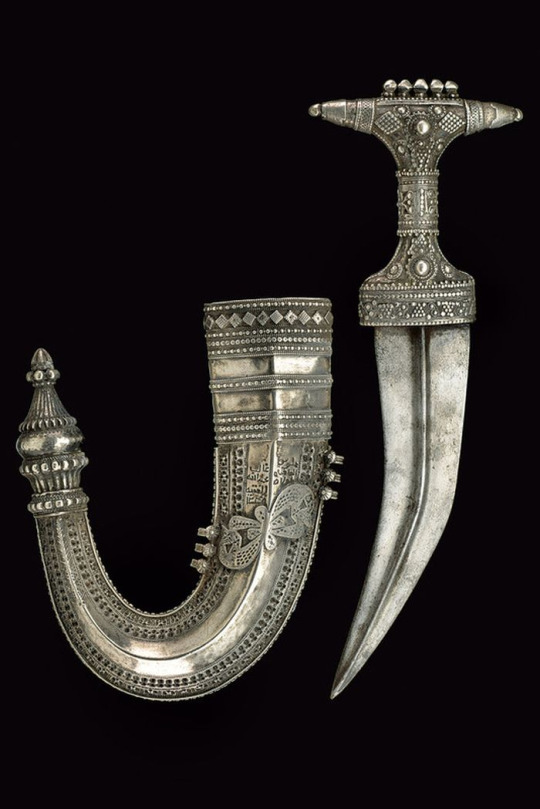
The second silver dagger (Christie's).
Above is the second silver-gilt jambiya dagger (30cm long), gifted to T.E. Lawrence in 1917 by Sherif Nasir at Aqaba after the Arab capture of that town from the Turks.  The dagger was auctioned by Christie’s on July 15, 2015, for a price realised of £122,500 (US $191,713).  (The price realised is the hammer price plus the buyer's premium).

Sherif Nasir was an Arab leader and cousin of Emir Feisal I, a Hashemite prince who was the third son of the Grand Sherif of Mecca, lead the forces of the Arab Revolt against the Ottomans from 1916-18, and was appointed king of Syria and then Iraq after the First World War.  Emir Faisal commanded the Arab forces alongside Abu ibu Tayi in the Battle of Aqaba, with Sherif Nasir participating and Lawrence advising.

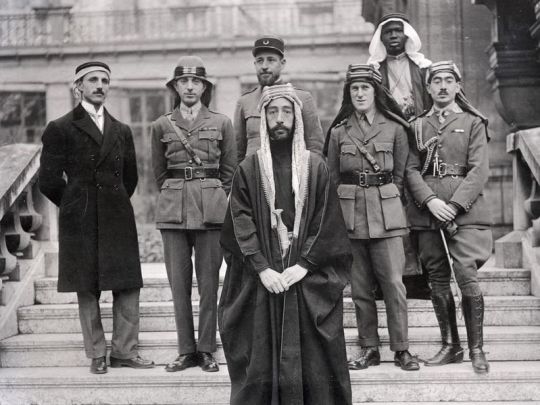
Emir Faisal’s delegation at Versailles, during the Paris Peace Conference of 1919. Left to right: Rustum Haidar, Nuri as-Said, Prince Faisal, Captain Pisani (behind Faisal), T. E. Lawrence, unknown person, Captain Tahsin Kadry (Wikipedia).
 In 1921, Lawrence left the dagger in the possession of sculptor and society hostess Kathleen Scott (widow of Antarctic explorer Captain Robert Falcon Scott), who had seen him at the ballet and not known who he was.  She would later comment to him in a letter that when she had first seen him ‘you had a turban on and I think I thought you had been born in it,’ which makes me wonder why he was wearing a turban to the ballet, who does that.

I have never seen Lawrence in a turban, and they weren’t worn by the Arabs where he was (they still aren’t), so I suspect that when Scott saw him at the ballet he was actually wearing a kefiyyah and agal like he did during the Arab Revolt.  There are many photos of him in one.  Still, why would a Welshman wear that at the ballet.

Scott saw him again at Waterloo station and requested a sitting so she could make a sculpture of him: 
Lawrence acquiesced, stipulating only that she did not ‘do me as Colonel Lawrence (he died Nov. 11. 1918)’. In fact, the resulting sculpture depicted him in just this manner, in full Arab dress, dagger at his waist. Of the sitting on 9 February 1921, Scott wrote: ‘Oh, what a very pleasant day, first Col. Lawrence came. We had great fun about dressing him up in his Arabian clothes, which he finally put on in the drawing room’. After his final sitting on the 20 February, he left the present dagger and robes with Kathleen, that she might continue her work while he sailed to Cairo; it would be over a year later, on the 28 August 1922, that he would write to request their return – ‘There’s a little artist wants to do an Arab picture, & has asked me for kit … Do you think you could provide some from your store?’ – later mentioning in a letter to Lionel Curtis in 1929 (see below) that the dagger still remained in the possession of Lady Hilton Young [Scott having married Edward Hilton Young, later 1st Baron Kennet, in 1922]. No such retrieval was made, and the dagger and the robes have remained in the possession of the family since then.  (Christie’s). 
Lawrence died in a motorcycle accident in 1935 and Lady Kennet died in 1947. This is the only one of Lawrence’s three Arabian daggers known to remain in private hands; it’s being sold by the estate of the last Lady Kennet following her death.

The first silver dagger was given to Lawrence by Sherif Abdullah, elder brother of Feisal and future ruler of the Transjordan. Lawrence presented it as a gift to the Howeitat chiefs in the Wadi Sirhan at the urging of Sherif Nasir - an investment lavishly rewarded by the support of the Bedouin in the assault on Aqaba, according to Christie’s.

 Lawrence appears with a dagger in many photos, including this one from the Telegraph article about the auction:
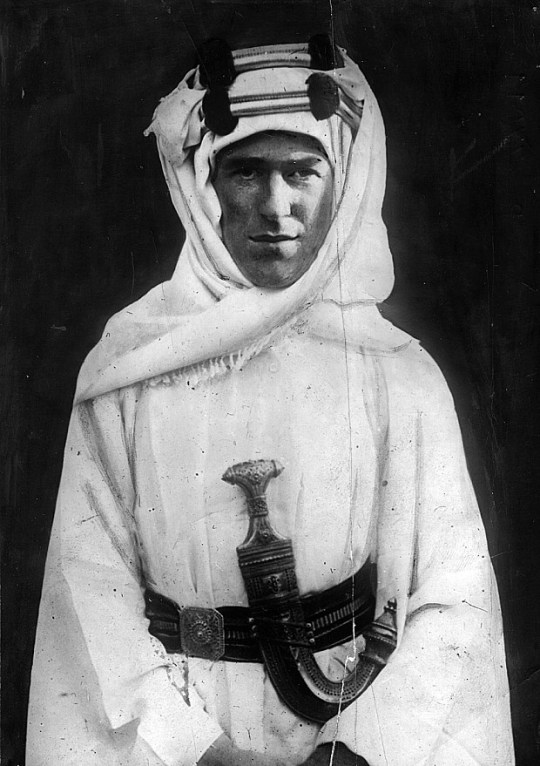

 I can't tell which dagger he's wearing. It's not the gold dagger, because the gold dagger is a lot smaller and its front bulges.  I think it might be the first silver-gilt dagger, which he gave away in Arabia, as it looks like the shape’s different from the shape of the dagger in the photo provided by Christie's - the point of the dagger being auctioned curves up all the way to the hilt.

Here's another photo of him in the desert somewhere, taken by B.E. Leeson in 1917.  I can't tell if it's the same dagger here either:

(National Portrait Gallery)
Here's a hand-coloured photo of him from 1917.  His dagger is tinted gold, but that doesn't necessarily mean it was gold.  It's definitely not the same shape or size as the gold dagger held by All Souls:

T. E. Lawrence in a classic pose from a photo in the Metcalf collection, 1917 (The Huntington Library).
 His third, smaller gold dagger was sold to his friend Lionel Curtis for £125, and subsequently presented to All Souls’ College, Oxford.  Lawrence was a research fellow at the college from 1919 to 1926.  The college still holds a thobe Lawrence wore, and the canteen set he used during the campaign.

Lawrence's mother gave these robes to All Souls College after his death, in 1938.  He adopted Arab dress in 1916 after being requested to when he joined the Arab forces, because he felt he could not gain the trust of the Arabs while dressed as a British officer, and because Arab dress was better suited to the desert.


Lawrence wore the dagger, discreetly acquired in Mecca in 1917, during the war; it also appears in the famous Augustus John portrait. He had it made small because a full-size one would have been too cumbersome. After the war he sold it to pay for repairs to his Dorset cottage, "Clouds Hill"; in 1938 it was given to All Souls College.  Lawrence had purchased the head-dress in Aleppo in 1912 and given it to his mother the following year. He recovered it to wear during the war because good quality examples were by then hard to obtain. (source).
About 1917 Lawrence had a canteen set made in Jidda to his own design. It included the plate, bowl, and spoon which he carried and used throughout the desert campaigns (source).
 A Hittite horse and rider. Lawrence kept the terracotta figure in his room at All Souls College in Oxford after the war. It dates from the ninth century BC and comes from the area of his excavations at Carchemish before the war (source).
 I haven’t been able to find a picture of the sculpture of Lawrence that Christie’s says Kathleen Scott made, or any other mention of it anywhere, so I’m not sure if it still exists or who might have it.  In 1920 Scott did cast a sculpture of T.E. Lawrence’s younger brother A.W. Lawrence, who was later Cambridge Professor of Classical Archaeology.  It’s a nude statue called "Youth" of a young man with his arms outstretched, which Kathleen Scott (by then Lady Hilton Young) presented to the Scott Polar Research Institute at the University of Cambridge for the opening of the Institute’s building in 1934.

Lady Hilton Young also presented a number of objects and papers to the Institute in memory of her first husband and his four companions, who died on their return journey from the South Pole in 1912.  The statue of A.W. Lawrence still stands outside the building (you can see it here.  It's a photo of the nude statue from behind).  The Latin inscription on its pedestal – LUX PERPETUA LUCEAT EIS – is translated as "let eternal light shine upon them."
Friday, 24 July 2015

Did a Muslim walk on the moon?

Someone once insisted to me that a Muslim space shuttle made it to the moon before the American one did. She was a teacher I had in college, and she thought that fact proved that Muslims were superior to Americans. I asked her when that was and what the mission was called and she just kept repeating the word for “space shuttle” in Arabic and eventually I gave up.

Some time later I got on the internet and did some Googling in both languages and found out that there was a rumour that Neil Armstrong heard the athan on the moon and converted to Islam there. (The rest of this story is under a cut).

Tuesday, 20 August 2013

On dying for one's beliefs, and on living.

There's an image going around Facebook and Tumblr (in Arabic, I don't know if there's one in English) of a woman in niqab and a man in a beard.  Yellow on black, like a yield sign, except the caption is to never yield and never give up your niqab/beard, not even if it costs you your life, because your fate is written.  This is in relation to the massacres in Egypt, where people have been killed who don't display those observances, but the ones who do are targeted especially.

The people I know who are sharing this are outside Egypt, and a few of them have put on niqab recently, and are encouraging others to do so.  I'm happy for them; I love my niqab and I understand how they feel about it.

I have to take my niqab off.

It's easy, to say that you would die for your beliefs, and it's exciting to resist, especially if you're young and the danger isn't immediate.  I understand.  I also understand that upper middle class girls in Amman aren't really risking anything when they put on niqab, except their neighbours' disapproval, and their families' puzzlement.  They won't lose their jobs, if they have them, or their housing, and they won't be shot.

I would gladly die for my beliefs, if it was a quick death, and if it would mean something.  What I won't do is give up my livelihood or accept a marriage I don't want.  I won't live a life of servitude or give up my autonomy. 

Given the choice between a beloved article of clothing and my larger principles, in this case, the clothing will have to go.

I feel guilty for thinking all of these things, when people are dying, but I don't think I've made the wrong choice.

Thursday, 15 August 2013

Both joy and sorrow as sharp as swords

I was backing up my files and found a pdf of J.R.R. Tolkien's On Fairy Stories on my external hard drive.  I didn't like The Lord of the Rings as much as I wanted to (as much as I like The Hobbit), I don't think I read it at the right age, but at its best, Tolkien's prose is lovely.  Here are some excerpts:

The realm of fairy-story is wide and deep and high and filled with many things: all manner of beasts and birds are found there; shoreless seas and stars uncounted; beauty that is an enchantment, and an ever-present peril; both joy and sorrow as sharp as swords. In that realm a man may, perhaps, count himself fortunate to have wandered, but its very richness and strangeness tie the tongue of a traveller who would report them. And while he is there it is dangerous for him to ask too many questions, lest the gates should be shut and the keys be lost.

Tolkien excludes fantastical travellers' tales, such as Gulliver's Travels, from the category of fairy-story, because "Such tales report many marvels, but they are marvels to be seen in this mortal world in some region of our own time and space; distance alone conceals them."

With respect to Tolkien, I think some of the above quote can be applied to travellers to foreign parts.  As far as our families are concerned, we peripatetics are in a perilous land.  They do not know the rules of the place, or where it's located to any degree of accuracy.  For all they know, we might be swallowed up or enchanted and never return.  We might as well be in faerie. 

We know the perils, and to us they are very ordinary - dishonest employers, landlords, corrupt officials, ever-changing immigration laws, annoyingly persistent matchmakers, stalkers in pointy boots and tight pants and too much hair oil.  No fairy lords here.  But there has been joy and sorrow as sharp as swords, and we will never be able to fully explain it to anyone who wasn't here with us. 

Tolkien wasn't fond of Shakespeare's pretty but dull fairies, or of the saccharine, moralising Victorian flower fairies.  He theorises about how this transformation from the wild fae of old happened:

Yet I suspect that this flower-and-butterfly minuteness was also a product of “rationalization,” which transformed the glamour of Elfland into mere finesse, and invisibility into a fragility that could hide in a cowslip or shrink behind a blade of grass. It seems to become fashionable soon after the great voyages had begun to make the world seem too narrow to hold both men and elves; when the magic land of Hy Breasail in the West had become the mere Brazils, the land of red-dye-wood.

And there's that thread from the LotR: the wonder that goes out of the world at the end of the age of elves and and the beginning of the age of men.

I think that's the right note to end on.  We are fortunate to have wandered, even if it won't last forever.  Nothing does.

Thursday, 8 August 2013

Dreaming: Ice-Cream

All I remember now is that people were pointing at me and saying I was a huge ice-cream cone.  I may have actually been a huge swirly soft-serve ice-cream, but I'm not sure anymore.

It's hot and dusty and often late at night in Ramadan I walked down to the baqalah and got an ice-cream. 

You can get a good one for ten to thirty qirsh, a vanilla bar coated in brown chocolate-like product or a tube of fruit sherbet.  They're not real ice-cream, they're milk and vegetable oil and fillers, but we're used to it.  Everything in this country is a cheap imitation, unless you're rich, but it's been so long since we've tasted the real thing that we wouldn't recognise it any more.  It's cold and it's sweet and it's affordable and that's all we wanted.

Ramadan's over now, and I think the midnight ice-cream runs are too. 

Wednesday, 17 July 2013

End of an era

It took me a long time to write this post.  I have a habit of hoping that if I just carry on and do the best I can and don't acknowledge that there's a problem I can't solve, it will work out okay, but that's not always true.  Pretending everything's perfectly fine when it isn't is not a good problem solving strategy. 

So, it looks like Jordan is no longer feasible for me.

I was taking (completely unnecessary) Arabic as a second language classes in the summer semester.  Or not taking, as happened more often, I registered and attended for a few weeks and then taking the bus and being around people and noise and sitting on a hard chair all day trying to pay attention with my back screaming at me and then taking the bus again and doing homework and then doing actual work and dealing with the usual bullpucky at home took their toll and I was no longer able to drag my carcass out of the house, which was not that big a deal because I graduated with honours from the last level at the language centre a few years ago.  I kept registering in the courses one semester (the shortest one) per year so I could renew my student visa and make contacts, I did a number of translations for teachers at the colleges I attended. 

The courses cost JD150 per semester, then JD250, and now JD750 (around a thousand dollars), and I would have to sign up for two semesters and actually attend, which is impossible for several reasons:

1. That is a stunning amount of money.  I have not made that much in all the time I've been here.  To put it into perspective, I have a decent apartment in a nice area in a quiet building close to a major university, and it costs me JD100 per month, utilities included.

2. I work, freelance, but I do work, and I have demonstrated several times that I am unable to work and attend school at the same time, and if I don't work I don't get paid and can't survive.

3. I was previously attending college classes, despite not being registered, because it's what I came here to do.  I wouldn't be able to do that if I had to go to classes at the language centre, and even if I had enormous amounts of money, I am not interested in sitting through basic Arabic lessons full time all year.

There are a few other options for renewing my visa in Jordan:

1. Enroll in university.  Not currently possible, because I have not been able to get the ministry of foreign affairs in Ottawa to authenticate my diplomas.  I have no idea what their problem even is, all they have to do is stamp them, this is not that difficult.  It was previously possible to register with unauthenticated documents while waiting for the documents to be authenticated, because it is a ridiculously byzantine process and commonly takes years, but the rules have apparently changed and Jordanian universities/colleges will not do that anymore.

Enrolling in university would also require me to find a scholarship, of which there do not appear to be any at this time.  Everyone I've talked to says they don't have any more to give out, partially because Jordan has been flooded with even more refugees in the past few years and non-Jordanian Arabs qualify for scholarships for foreign students.  Which I don't begrudge them at all.

There are plenty of people lining up with potential husbands for me, who they say would pay for my education (they frequently say that, and then don't.  I've seen this happen often enough.  Especially if they refuse access to birth control, and the girl gets pregnant immediately.  There goes that hope right out the window.  She could demand a divorce if she specified in the marriage contract that he would pay for her education and he didn't keep to the terms, but then she's divorced and has small children and no support, in a society that heavily stigmatises divorced women and has a huge surplus of poor unmarried girls). 

Marriage is my other option for renewing my visa, and my reaction to that is basically nopetopus.gif.  I am physically and constitutionally unable to fill that role, and I'm not interested in being treated like property again.  Been there, done that, ripped the T-shirt up for rags, it was a piece of junk anyhow.  If someone was willing to sign a marriage contract with me to put an end to my visa troubles, and let me live my life?  Maybe I'd do it, maybe we could be friends and partners, but people don't behave that way.  That's not what they want when they marry a lady.  Also, I'm not able to make enough money in Jordan to survive, nor am I able to go to college, so staying here would probably be locking myself into a dead end.

When I found out that the visa requirements had changed (without warning, as they always do), I began looking at options outside of Jordan.

 - Egypt: was tentatively planning on going there, but that's no longer an option.

 - Syria: hasn't been an option for a few years now.

 - Saudi Arabia: ahahahaha no, why do people keep suggesting this.


- Turkey: expensive, has actual standards and requires qualifications I don't have.

 - the UAE: had a couple job offers here, none of which I was qualified for or capable of doing.

 - Canada: I could possibly borrow money from family to go back, but I would have nowhere to go once I got there.  I can't go back to the places I used to live, the intelligence service there was a hassle, I have no means of financial support, there are people there who I'm very glad to be half a world away from. 

And I'm not ready to give up on my education and my beginnings of a career here.  I would feel terrible if I gave up and went back to a place where I wasn't safe and have no future.

This would be a lot easier if I was either wealthy, able-bodied and healthy, educated, or had Muslim family here.  As it is, I'm flat broke and not in good health and not interested in trading my body, so I've had to turn down all the offers I've had so far.  Yes, I could take a job I'm not capable of doing and hope it takes them a while to fire and deport me, but that is really a terrible idea (which hasn't stopped several people from suggesting it.  No, the problem is not that I'm not trying hard enough to succeed).  Also, I don't have money to travel.

And my visa expired nearly two months ago.  Damnit.

Tuesday, 4 September 2012

I took a stand today

I took a stand today. Just a little one.

I was in the kitchen squeezing the soapy grey water out of my laundry. An older woman was unlocking occupied rooms and showing them to two girls. I think I've seen the woman before, but I don't know who she is.

"You're in the private room?" She asked.

"Yep."

"I'm going to show it to these girls." She threw another door open. There were scarves on the unmade beds and open books on the floor. Dorm rooms never have desks.

The girls peered into the room. I looked away. I know the girls who live there. "Nope. It's occupied."

"We're going to go see it now."

"No. I live there."

"I'm showing them the dorm."

"They don't need to see my room. I'm not moving."

"No, I'm showing it to them." She puffed her chest out and glared at me. This could go on and on.

"It's not clean."

"Oh." They went and looked at more rooms.

I left my wet clothes in the tub, went back to my room, and locked the door behind me. I left the key in the lock.

This is the first time in three years that I've had any privacy. It's not that I couldn't afford my own room before, just that dorm supervisors would never allow me to have one, regardless of how many rooms there were and how few residents. We were not allowed keys to our own rooms, and subject to search at any time. Anyone could invade my space at any time, and I couldn't stop them. And so I spent two, nearly three years basically a houseplant, not talking to anyone, not writing, barely even thinking. I got myself into a bad situation and couldn't escape, so I withdrew.

I finally managed to pry myself loose and got out. I found this tiny room, and I pay more for it than some of my friends in other towns pay for their apartments, but I don't even care. It used to be the men's washroom - the dorm supervisors say it didn't, but the tiling and the sawed-off plumbing and the fixtures and the painted-over sign on the door and the women's washroom right next to it reveal their lie. I don't care.

Because it's mine, and I will not let anyone invade my space if I can help it. Little power struggles like this are just one more way that dorm supervisors - and older women and people of higher status in general - impress on young women that they have no control over their own situations and no right to refusal. It's a lot like prison.

So when something large and heavy slammed into my locked door, I smiled. The door handle rattled violently, and metal scraped against the keyhole, but my clunky old skeleton key didn't even budge.

I expected the woman to pound on the door and shout at me to open it. I was going to refuse, and throw myself against the door if need be, and probably be evicted.

But she went away silently. I won't win them all, but I won that one.


Thursday, 16 August 2012

A never-ending stream of bloated corpses

I've been struggling for some time, trying to find a polite and socially acceptable way to say this, but I don't think there is one. I think this is one of those things that you must not say, but it bothers me, and I think it needs to be examined. So I'll just say it.

Please forgive me if I offend you, it's not intentional, and I'm probably not talking about you.

A number of people have been flooding my Facebook wall with images of corpses from the war in Syria (and some from Burma). Usually corpses of children or infants, or adults with young children crying over them, or just piles of corpses. Bloating and rotting and covered in blood and dirt and shredded clothing.

They all have two things in common: they're as graphic as possible, and they're posted by people who do not live in the Middle East.

I'm not sure why the posters post them. They seem to be trying to raise awareness, which is a valid concern in North America or Europe or Turkey. People in those countries might forget about the atrocities happening in Syria, because they don't deal with the survivors on a daily basis.

I do. I donate my time and knowledge to teach them English, and give them clothes and food and what money I can. I've been to the refugee camps near the Syrian border and I know that even though I do everything I can, it has little or no impact on the daily lives of refugees in Jordan, much less people in Syria. Or Gaza. Or Somalia. Or Burma. Jordan is flooded with refugees, and I see their desperate situation and confront my own helplessness in the face of it every day.

I don't want to go on Facebook and see a continuous wall of corpses reminding me of these things. That may be selfish. So be it. No one else is going to look out for my mental health. So I deleted a few people who posted nothing but dead babies and unsubscribed from quite a few others, without warning or discussion. Those pictures still come up, but it's not continuous anymore. I'm not advocating pretending the conflict doesn't exist, I just need a break from it.

There's an even bigger problem with these photos and Muslim chain letters: they're graphic to the point of voyeurism, and devoid of context. They're not attached to articles about the conflict, or commentary from people who survived. It's just gore.

And here's where my understanding breaks down. Why do people in other countries post disaster porn? What purpose does it serve, for the posters or the people caught in the conflict, and how does it help? People far from the conflict see the images, slow down and gawk like motorists passing a pileup on the highway, and then move on. They don't stop to help, they just want to have a look at the damage.

I don't entirely buy the 'raising awareness' justification. People think that's why they do it, but I don't believe it's the real, complete reason. This is one of those dark corners of human psychology that we'd rather not look too closely at.

Somebody do a study on this, because I just don't understand.

I'd appreciate comment, but please keep it civil.

Saturday, 28 July 2012

Walk like a lady

TW: rape, victim blaming.

Our dorm's curfew is eight thirty pm in the summer, but I got permission to go to taraweeh prayers at the masjid across the street during Ramadan. I'm the only one in the building who goes. Taraweeh ends around eleven pm. The dorm supervisor usually calls me at ten thirty to ask why I'm not back yet, but I'm in the masjid and I'm praying so my ringer's turned off. She knows perfectly well where I am and what I'm doing.

Instead of going to taraweeh today, I went to the souq and bought food. Because I had none, and nothing is open until after ishaa, and I'm diabetic. I eat or I die.

It was a Saturday evening during Ramadan, so I waited a long time for buses, and I walked a long ways. Some of the streets in the souq were dead, nothing open, and some were packed wall-to-wall with people and cars. Most of the vendors wanted twice the usual prices. I sat at the mujamma'a for half an hour, waiting for the bus to fill up with passengers and leave.

So it was quarter after eleven when I got home. The dorm supervisor and some of the girls sit on the main floor (the third floor) smoking and talking and watching muselselaat (soap operas) and watching the stairs. Nobody gets by unnoticed.

They stopped me on my way up the stairs, dead tired and loaded down with vegetables, and asked me, with obvious suspicion, how many raka'at I prayed this time. I told the truth. I went to the big masjid in the souq, against the rules and without permission, and prayed the minimum number of raka'at, and then bought food. They berated me for breaking the rules. I don't think that people who don't pray or practice their supposed religion have any business criticising me for doing halaal things.

The dorm supervisor said that she was about to bolt the door, and if I was any later, she would have locked me out.

I believe she would lock me out; it's common practice in dormitories. Any girl who stays out late is obviously bad, and deserves what she gets. And the dorm supervisors know that I don't recognize their authority or abide by their rules. I've got it coming.


Basically, she gave me a choice between death by diabetic coma, and a shallow grave in the desert.


Groups of men hang around in the parking lots outside our building. I've been surrounded and attacked several times in this area, coming home from work in the evening. I fended them off with rocks and blows and shouting. I guess they weren't that determined, and Allah was with me.

I don't carry a knife anymore, and I know it's stupid and I'm putting my own safety at risk, but if I was armed I would stab the next man who touched me. I don't think I would be able to stop. And I don't think I'd be able to live with myself after that.

When I told the dorm supervisor, she said they assaulted me because I was afraid. Right, because fear totally causes gang rape. Other women said it was my own fault for being outside. Or for wearing colour. Or for having pretty eyes. Here's a tip, folks: nothing women do or don't do causes rape. Men raping causes rape. Society blaming the victim and not the attacker perpetuates rape.

I'm conscious of the men eyeing me, and I'm aware that I'm not safe, but I'm not afraid. I hold my head up and walk like someone you do not want to mess with. Women tell me to walk like a lady, slowly with small steps, don't draw attention, don't make men desire you. I don't care. Meekness gets you nothing but abuse in this world. The next man who gropes me will lose a nut, and people can think what they like about it.

Monday, 16 July 2012

Magic Powder

I was lying in bed, with the window shut in an attempt to muffle the sound of hammers and powersaws, and the door open in an attempt to get some airflow.  It was past three am, and it was stuffy and smoggy and probably forty five degrees indoors.  I had to wake up at four thirty to pray, and again at seven at the very latest to get to school by nine.  I was pretty sure I wouldn't get any sleep. 

Perhaps reading something boring would help.  A two-volume explanation of a thousand-line poem about grammar, written twelve hundred years ago might do it, and then I could honestly tell the instructor that I'd read ahead.  I opened my eyes, and watched a dark blob dash across the line of pif-paf in the doorway.  I could hear its barbed legs skittering on the tiles.

Pif-paf is supposed to give "long-lasting protection against cockroaches, ants, bedbugs, fleas, lice, and all forms of crawling insects."  Says so on the can.  Everyone recommends it.  I shake a thick line of the powder across the threshold of my teeny room every night, like a sorceress in a fantasy novel warding the doors to keep evil creatures and spirits out.

The thing with cockroaches is, nothing works on them for very long.  Stores here have a whole aisle devoted to roach sprays and powders and who knows what else, and I've tried all of them, and I'm pretty sure they bother me more than they bother the roaches.

I got up, flipped the light on, put on my flip-flops, and chased the roach out of my room.  They're harder to catch than you'd think. They're damned fast, especially the big ones, they run in a zig-zag pattern which always makes me think of Captain Picard saying "evasive maneouvers!," they can jump and fly, and they run up walls and upside-down along the ceiling just as easily as they run along the floor.  You want to catch them on the ground, in the middle of the floor.  If you corner them, they'll jump at you, or run up the wall.

I stomped the cockroach, several times for good measure, and opened my cupboard to get the can of pif-paf.

There was a cockroach in there too, an even bigger one.  I've seen smaller mice.  I sucked in a breath and quietly said a very bad word.  It panicked and scurried around the cupboard, up the walls and around the ceiling a few times, and then hid behind the jars of dish soap and vinegar and pif-paf.  Clearly the stuff was not all that repellent.  I really didn't want to deal with the roach, so I grabbed the pif-paf, and slammed the cupboard door shut.  Even enormous roaches can squeeze through amazingly small cracks.  It would be able to get out of the cupboard with the door shut.

I dusted a small mountain range of pif-paf across the doorway.  I knew perfectly well that the stuff didn't keep roaches out, but I chose to believe that it did.  Admitting it didn't would be admitting that no matter what I did, creeping skittering things with too many legs that bend in the wrong places come into my room at night while I am sleeping, and there is nothing I can do to keep them out.  And that way madness lies.

So I say bismillah and make lines of useless magic powder and do not look at the door and believe I will be safe, like a little kid going through a precise routine every night as she climbs into bed, because if she gets it exactly right, the monsters can't get her.

I went back to bed and as soon as I closed my eyes, the athan went off, and I got up to pray, and I did not see any cockroaches. 

I didn't go to school that day.  I hadn't gone the day before either.  An instructor complained that I did badly on a test, and I told him that I was running on maybe three hours of sleep and way too much coffee and I was just glad that I had made it in and written the test, khalas it's done lets move on.  But masha'Allah, you're so smart, he said, you should do better than this.  My students are like my children, I want them to do well, why did you get this answer backwards?

Smart, maybe, when I can pay attention, but I'm also neurotic as a pile of lemurs.  Making it through the day without any major mishaps is success in my books, lately.

I woke up at eight and said to hell with it and went back to sleep and had weird dreams and woke up again at noon, and was pissed off because I never sleep that late even when I go to bed at fajr and I'd just slept through half the day and I'd probably be up till fajr again.

I got up to make coffee and get my ass in gear and my dreams were slipping through my fingers and the freakiness dissolving and I opened the cupboard door and the enormous cockroach I'd not wanted to deal with the night before took a running leap right at my face.

I stepped back out of its way, swore quietly, and watched its parabolic arc to the floor.  It had panicked and tried to escape and there was nowhere to go but out of the cupboard and I was in its way.  It wasn't malicious, but still it was a roach and it was in my house and I didn't want it there.

The roach hit the grimy linoleum, flailed its legs and took off running.  Before it ran six inches I brought my flipflop down and crushed it, then stomped it a few more times and watched its legs twitch and crumple like the poles of a collapsed tent.  I always feel bad having to kill roaches.  Allah made them too and they're big enough that they have faces, and intelligent enough that I can empathize with them, but I can't live with them.  I stomp monsters out, wherever I find them, so that I have a chance of sleeping at night.

Every time I go to open a cupboard door now, I panic a little.  I clench my jaw and stand up straight and just open the damn door.  If something jumps out at me I'll crush it into oblivion, but I'm still afraid. 

Afraid of cupboard doors.  What the hell, God?

Sunday, 27 November 2011

Word of the day: zanikh زنخ - rancid

A couple of my med-student flatmates used this word several times in conversation, with particular emphasis on the 'ikkkhhhh.' I wasn't paying attention to what they were saying, but this word flew back and forth and caught my ear. I have an irritating habit of whipping out my little notebook every time a hear a new word, interrupting the conversation, and asking everyone in the room if they have a synonym in their own dialects. They almost always do. They tease me that I'll never learn all the dialects, and they're right, I won't. Every person I meet speaks a different one.

I think words that describe something gross should have a 'kh' somewhere. There's wasikh (dirty), and kherbana (busted, wrecked when describing object, or rotten, when describing something edible). People draw out the 'kh' sound to show their disgust.

My friend's son, at a year old, would stand in his crib and say 'ikkkhhhhh,' especially if he knew he was doing something he knew he shouldn't be. It was one of the first distinctly Arabic sounds he learned, I think because he heard it so much. Whenever someone caught him rooting through the garbage or the diaper pail, they'd say 'ikkhhh,' and pull him away. Laughing when he said it back didn't help keep him out of the dirty diapers.

I've heard badly behaved people described as having 'rancid blood.' As one of my flatmates put it:


نقوله (دمه زنخ) عن بني أدم عندما حركاته مش منيح

Friday, 4 November 2011

Rain

I woke up slowly on this Jumua' morning two days before Eid. It had to be late, but the light filtering through the drapes was mellow, and the air was still cool. I was half-aware of a strange sound coming from outside. Pink patta patta pink patta patta pink plonk.

Rain. The first rain we've had all year. And a grumble of thunder, and irate drivers leaning on their horns.

The little stone courtyard at the bottom of the stairs was flooded, an inches-deep swimming pool and graveyard for stranded cockroaches. They're not very good swimmers, it turns out.

The leaves on the fig and green lemon trees, dusty, brown-edged, and wilted yesterday, were crisp, green, and vibrant.

This is better than Eid, better than Christmas. People who haven't been able to water their crops or wash their clothes or bathe properly or drink clear water for nearly a year just got the best gift God could give them.

Not a gift we're prepared for, however. The sound of sirens and honking reminds me that the roads are certain to be flooded. It rains so rarely here that there are no drainage systems to speak of. Many people with ground floor flats will be sloshing through a few inches of cold water and wishing they hadn't bothered putting the winter carpets down. I don't have any clothes appropriate for going out in the rain, and most working-class people won't either. All the people living in tents will be cold and miserable for the next few months. Some of them will die, children and the elderly and even young adults, struck down suddenly by ordinary illnesses that could be easily treated, given access to medical care and better housing.

As mixed a blessing as rain is, it is still a blessing, and cause to celebrate, for those fortunate enough to have dry-ish houses, warm sweaters, and good friends this Eid.

Monday, 15 August 2011

Figs

It is wonderful to be tall.

I stand on a broken chunk of cement and reach up into the highest branches of a fig sapling sprouting through a crack in the buckled asphalt of the exercise yard.

On the other side of high concrete walls and rusted barbed wire, factories hum and whir and pump black smoke into the sky, obscuring the stars.

Unseen among the rocks and refuse of the wadi, someone pounds out a rhythm on an empty plastic tub.

Indoors, girls shriek and laugh shrilly, clink cutlery on plates, scrape plastic lawn furniture across bare stone floors. Fluorescent lights glow pink through drawn curtains striped by iron bars.

The exercise yard is still and empty; no one sees as my fingers search through rustling leaves in the dark, gently squeezing smooth round fruit, twisting ripe figs free.

Growing unasked for and uncared for, they are small and green and dusty. I eat them without bothering to wash them, standing beside the scrawny tree, and they burst in my mouth, warm and moist and sweet. The air is so thick with dust and pollution that eating a little more grime makes no difference.

I search out more figs and eat until my mouth is tingly and fuzzy, as though I had eaten a honeybee.

Figs bought in the souq in the light of day could never be so sweet.

Saturday, 19 March 2011

haiku

I learned crunchily
While drinking tea with fresh mint
Look out for small snails

Sunday, 27 February 2011

Christmas Chocolate

A student went around the living room one evening offering everyone something out of a box. Several people accepted a piece, took a bite, and then looking like they’d expected lamb and gotten overcooked mutton fat. I asked the student what was in the box, and she told me that it was special fancy chocolate her brother in Ottawa had sent to their family in Saudi Arabia.

I read “Life Brand Dark Chocolate Cranberry Pistachio Bark,” on the lid and smiled.

“Do you know it?” The student asked me. “It’s supposed to be a very good brand, isn’t it?”

“It’s popular,” I said, trying not to laugh, and accepted a piece. It was strong and bitter and sweet, and the only chocolate I’ve had in a year and a half that tasted like chocolate used to.

Buying half-price drugstore holiday chocolate in the aftermath of Christmas was one of my favourite traditions as an adult in Canada, a bit of sweetness after the long shifts at work, bitter fights, bad behaviour, and drunkenness of a holiday I didn’t believe in and would rather have skipped.

I don’t think I would have had the gall to send it to relatives overseas and tell them it was a Canadian specialty, but in truth it is.

Saturday, 26 February 2011

Windstorm

A windstorm comes out of the desert, bending the few scrawny pine trees parallel to the ground and howling around buildings. One whole end of the college is open to the outside, and the wind rushes in and down corridors, rattling windows and sucking at doors. If doors are left open, and people never seem to learn to close them, they will slam them so hard that the handles fall off, sometimes hard enough that the brittle wood shatters. The narrow stone stairwells become blocked for several stories with lemming-like students, every one in turn trying to force the handle-less door open, finally deciding to double back and find a different route to their lecture, and having to shove their way through a mass of other students all going through the same process. 

The wind carries dust and grit from the desert, and pelts it against everything in reach. It drums against the windows, sands the paint off cars, and coats the cabbages and radishes in the farm plot next door with a layer of sandy brown. The wind buffets struggling pedestrians, tearing at their billowing abayas and thobes and scarves. Everyone who doesn’t wear niqab shields their face from the dust with a scarf or a book.

After a few days of howling wind and blowing sand, I wake up in the night to the sound of raindrops tapping on the windows, and rushing water. It is raining hard somewhere, and torrents of muddy water come gushing out of the desert and into the wadi, water turned the colour of chocolate milk by the soil it carries from far away. I listen to the little river behind the school roaring, the wind howling, and the pine branches rustling, and I remember the crashing waves, and the wind in fir trees, and the unearthly silence of falling snow in my former home, far away across oceans and continents, and I fall back asleep.

Monday, 14 February 2011

Photos from Jerash

I don't know what to write about, so let's have some photos. I must have several hundred just of Jerash, but these are some of my favourites.

I visited the excavated Roman ruins at Jerash several times last year, although we only actually got past the front gate once.

Here's Hadrian's Gate at the entrance to the site, built for the visit of the emperor Hadrian in 130 AD.


Some of the artifacts that have been discovered. The site has been occupied for around five thousand years; it was conquered by Rome in 63 BC, and mostly destroyed by earthquake in 749 AD. The monuments visible have all been dug up and reconstructed; there is scaffolding and a pile of stone blocks behind Hadrian's Gate, as it is still being assembled.


Most employees at historic sites don't mind having their pictures taken.

A man selling trinkets at the entrance to the South Theatre.


This 'gladiator' seemed to be having a good time striking fierce poses with his sword for the pretty foreign students.


The Hippodrome has mock Roman military demonstrations, chariot races, half-nude middle-aged Arab guys very earnestly trying to sword fight to the death, etc.


It's a big site. The air here is always more or less hazy, but you can (hopefully) see that the Cardo (north-oriented paved road bordered by pillars) winds its way all the way up the hill to the left. I was delighted the one time I was able to walk all the way through it, although I was the only one who did.


The little souvenir souq that the Turkish study groups often never leave. I just don't see the interest in it, but then I dislike shopping and knick-knacks in general. To each their own.

Thursday, 3 February 2011

Rain at Last

Jordan is mostly a very dry place. It doesn't have any major bodies of water to draw from, so it mostly depends on rainfall, which isn't that plentiful in a country that's mostly desert. What about the Jordan River? I've seen it a number of times, and from the hills it's hard to tell that it is a river, there's so little water in it.

Back in November, the Jordanian government called for people to fast for three days and then gather all over the country to pray salaat al-istisqa, the prayer for rain. There were posters everywhere, and a group prayer was held in the paved yard of my college. The rain did come, I don't recall exctly when, but shortly after the prayer. Some people will say that it was going to rain eventually anyways and praying has no effect, but personally I believe that Allah heard our prayers, forgave us, and send the rain.

Rain in the desert after nearly a year of dust and dryness is a miraculous thing to witness. The water has nowhere to go, so streets and many houses flood; the whole town is shut down and classes are cancelled, very much like the effect a few inches of snow has in a certain pathetically and chronically unprepared city in Canada.

Despite the problems it causes, children stand rapt and watch the raindrops fall, and adults rejoice. I was standing under the eaves of the masjid, sheltering from the rain while waiting for it to open, and a woman joined me. She remarked happily about how lovely the weather was, and I thought for a moment that she was joking. In Canada, pouring down rain is ordinary and dreary, but here it's a miracle that only happens a few times a year.


When it finally rains, it really rains. Water comes rushing down out of the higher desert and fills the wadis that were formally used as footpaths, playgrounds, and garbage disposal with torrents of chocolately brown water. It happens very suddenly, and I wonder every year if anyone got caught in the wadi when the water came crashing down.


Tuesday, 1 February 2011

Tombs of the Sahaba

The tomb of one of the many Sahaba who died in Jordan during the Amwaas plague outbreak in the year 18 after the Hijrah (639-640 AD). Unfortunately, I have visited a lot of their tombs and can't remember who this one belonged to. All I can make out for sure from the photo is that he was an Ansari (one of the Muslims of Medinah who helped the Muslims from Mecca after their migration to Medinah).

An estimated 25, 000 people died in the plague outbreak, including many of the Sahaba who had liberated balad ash-shams from Roman rule (or conquered it, depending on your perspective). Many people don't know that these Sahaba died of plague, and not in battle.

This tomb is not very fancy, as they go, but most of the ones I have seen are huge affairs of polished marble, golden cages, and embroidered velvet. The bravery, faith, and sacrifices of these men who died so far from home should be remembered, but erecting shrines to them seems like too much to me. It's not in keeping with the Islamic burial practices, in which the corpse is wrapped in a plain white sheet and quickly buried in the ground, to absorb back into the earth from which it was made.


I believe this was the masjid in which the tomb above was located although it may have been a different masjid holding the tombs of other Sahaba. I took the pictures last spring, and only recently had them developed.

I found it lovely, simple, and peaceful, down in the Jordan valley where things are actually green some of the time, although far richer than most of this dusty land.

It bothers me that so much is spent to glorify men dead nearly a millenia and a half, when most people here work so hard and live in poverty and difficult conditions, with little hope of anything better.


Wednesday, 29 December 2010

I'm still around.

Just busy. I'm studying in college, and at the masjid attached to my college, and tutoring English, so I don't get on the internet much. I've been trying to convince the school to stop using Internet Explorer 6, but no dice so far. It's a miracle it even still sort of works.

I've been jumping out of my skin several times every day (and night) when the fire alarm goes off. It's definitely winter now, or what passes for winter here, because the girls are leaving things to cook on the electric heaters, and of course forgetting about them and setting the fire alarms off. It would not be as annoying, if not for the fact that most of the girls in the dorm stay up most of the night, so that's when the majority of the alarms go off, and they won't go and shut them off. Getting woken up and scared out of my wits by the extremely loud bells a few times every night is getting really irritating.

I'm afraid that one day there actually will be a fire (not that it would be that big a deal, since there's not much that could burn), and I'll have rolled over and gone back to sleep, and we'll all suffocate, so I get out of bed and go deal with the alarm, and try to be patient with whoever set it off. My strong fear of fire seems very unreasonable to everyone here; I think it stems from growing up where everything was made of wood or fabric, seeing houses go up in flames like piles of tinder as a child, and having fire safety drilled into me in elementary school. I suppose to a group of very inexperienced girls who have never seen fire, it doesn't seem like anything to get worked up about.

Happy New Year to everyone :)