Showing posts with label book review. Show all posts

Sunday, 4 October 2015

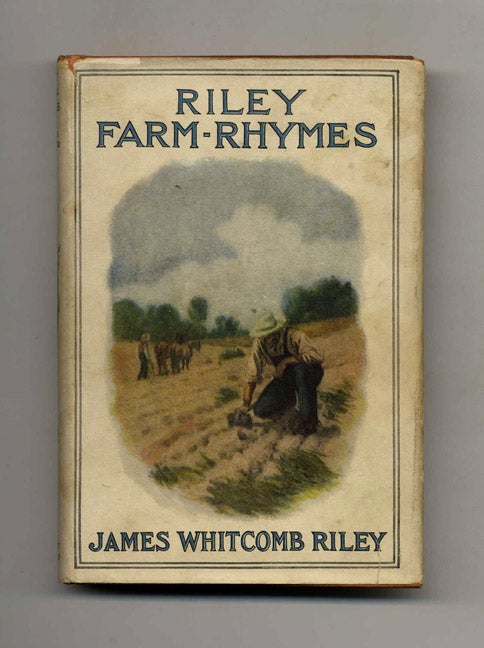
Book Review: Farm Rhymes


This 1905 edition is selling for $140, but you can get the ebook free (source).
Verdict: enjoyable, three out of five stars.

American poet James Whitcomb Riley (1849-1916) had only an eighth-grade education (he graduated when he was twenty), but he was a successful newspaper reporter and a very popular poet in the 1880s and 1890s.  Farm Rhymes was first published in 1888 and the poems are quite Victorian and sentimental, but I think this collection holds up better for modern adult readers than Riley's children's poems or humorous poems do, although the latter two were more popular in his lifetime.

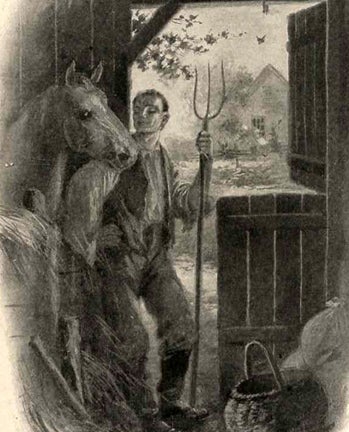
Farm Rhymes is a short collection of simple poems about rural life, written in either Indiana dialect (I didn't find it hard to understand, and I'm not American) or standard late nineteenth century American English. Topics include harvest, fishing, family, nostalgia for childhood, and descriptions of nature - birds and woods especially. There are black and white illustrations for each poem; only a third of the pages have text on them, and there's not a lot of text on each page. 

One of the illustrations.

 I read this book in about an hour one morning, it's really very short. My favourite poem out of the collection is 'When the frost is on the punkin.' It's fairly widely published on the internet, and seasonally appropriate.

When the frost is on the punkin and the fodder's in the shock
And you hear the kyouck and gobble of the struttin' turkey cock
And the clackin' of the guineys, and the cluckin' of the hens
And the rooster's hallylooyer as he tiptoes on the fence
O, it's then's the times a feller is a-feelin' at his best
With the risin' sun to greet him from a night of peaceful rest
As he leaves the house, bareheaded, and goes out to feed the stock
When the frost is on the punkin and the fodder's in the shock

They's something kindo' harty-like about the atmusfere
When the heat of summer's over and the coolin' fall is here
Of course we miss the flowers, and the blossums on the trees
And the mumble of the hummin'-birds and buzzin' of the bees
But the air's so appetizin'; and the landscape through the haze
Of a crisp and sunny morning of the airly autumn days
Is a pictur' that no painter has the colorin' to mock
When the frost is on the punkin and the fodder's in the shock.

The husky, rusty russel of the tossels of the corn,
And the raspin' of the tangled leaves, as golden as the morn;
The stubble in the furries kindo' lonesome-like, but still
A-preachin' sermuns to us of the barns they growed to fill;
The strawstack in the medder, and the reaper in the shed;
The hosses in theyr stalls below the clover over-head!
O, it sets my hart a-clickin' like the tickin' of a clock,
When the frost is on the punkin and the fodder's in the shock!

Then your apples all is gethered, and the ones a feller keeps
Is poured around the celler-floor in red and yeller heaps;
And your cider-makin' 's over, and your wimmern-folks is through
With their mince and apple butter, and theyr souse and saussage, too!
I don't know how to tell it but ef sich a thing could be
As the Angels wantin' boardin', and they'd call around on me
I'd want to 'commodate 'em all the whole-indurin' flock
When the frost is on the punkin and the fodder's in the shock!
A scan of the 1901 edition of Farm Rhymes is available for free on the Internet Archive. The epub doesn't preserve the line breaks and the scanning program garbled the dialect beyond comprehension, so I read the PDF.  More of Riley's works are available for free on Project Gutenberg

Monday, 14 April 2014

Book Review: Memoirs of a Smuggler.


Memoirs of a Smuggler: Compiled from His Diary and JournalMemoirs of a Smuggler: Compiled from His Diary and Journal by John Rattenbury
(J. Harvey, London, 1837).

aMy rating: 3 of 5 stars

The ebook is available for free from Google Books (PDF or epub; the epub has a few scanning errors) or from Smugglers' Britain (html, proofread).

This is Jack Rattenbury's account of his exploits as a smuggler, mainly between France and the Devon coast, in the late 18th and early 19th century.  According to this website, a Unitarian pastor, John Smith (who was also involved in smuggling) helped him write it.

Born in 1778, Rattenbury went to sea as a fisherman at the age of nine, but soon left and took up as a privateer by the age of 15. From that point on, he was constantly pursuing and being pursued by French and Spanish vessels, and made many daring escapes - or so he tells us.

Returning home from privateering at the age of 16, Rattenbury says he
...remained at home about six months, part of which was occupied in fishing, but I found the employment very dull and tiresome after the roving life I had led; and as the smuggling trade was then plied very briskly in the neighbourhood, I determined to try my fortune in it" (pg. 11).
Rattenbury spent the next thirty years alternately smuggling, fishing, piloting, and running a public house which ultimately failed. His account is mostly a fairly dry recitation of the trips he made, places he went, and ships and cargoes he lost, but there are dramatic bits when he's chased by the preventive services and has to toss his tubs of spirits or tea overboard and hope to haul them up later, before the king's cutters or local inhabitants do and before they spoil.

Some of his anecdotes seem exaggerated for effect, as when he tells how he deserted from the Royal Navy and, in between smuggling trips, a militia sergeant found him in a pub and tried to capture him.
...in answer to his charge, I replied, “Sergeant, you are surely labouring under an error; I have done nothing that can authorize you in taking me up, or detaining me; you must certainly have mistaken me for some other person.” In this manner, I contrived to draw him into a parley; and, while it was going on, I jumped into the cellar. I then threw off my jacket and shirt, to prevent any one from holding me; and, having armed myself with a reaphook, and a knife which I had in my pocket, I threw myself into an attitude of defence at the entrance, which was a half-hatch door, the lower part of which I shut, and then declared that I would kill the first man who came near me, and that I would not be taken from the spot alive. At this, the sergeant was evidently terrified, but he said to his men, “Soldiers, do your duty, advance and seize him;” to which they replied, “Sergeant, you proposed it: take the lead, and set us an example, and we will follow.” No one, however, offered to advance, and I remained in the position which I have described, for four hours, holding them at bay (pg. 52).

A group of women then came into the pub and claimed that a boy was drowning, and Rattenbury claims that he charged through the militiamen, and because he had taken off his shirt, they couldn't catch him and he was able to jump into a boat and escape. A tall tale if I ever heard one.

At least once, Rattenbury smuggles people, in this case, four French officers who escaped from custody in England:
They came to Beer, and I concealed them in the best manner I was able, in a house near the beach, where I supplied them with such provisions as they wanted. But a vigilant inquiry was commenced; their steps were traced, and the place of their retreat discovered. The next morning, there was a special warrant out against myself and five others, who were connected with the affair, and the constables came to my house, while I was up-stairs considering how I had best act. Finding that my companions had absconded, and being captain of the boat, I immediately surrendered myself up to them. I was then taken before the magistrates, where I found the French gentlemen in custody. They were examined through the medium of an interpreter, but their replies were cautious, and they said very little that could tend to implicate me in the transaction. My turn then came; and, in reply to the questions from the bench, I briefly stated that I was engaged to take the gentlemen to Jersey, of which island I understood that they were natives. A lieutenant of the sea-fencibles being in the room, asked me if I did not know a native of Jersey from a Frenchman; to which I was going to have replied, but my attorney, who was present, said that this was a question which he had no right to prefer, and which I was not bound to answer. The magistrates then conversed together; and, after a little consultation, dismissed me, with a gentle admonition to go home, and not engage in any similar transaction for the future (pg. 51).
Rattenbury and his sons and gang of smugglers (he doesn't go into any detail in the narrative, but you can read about them here) are frequently on the wrong side of the law. Rattenbury repeatedly escapes the preventives and press-gangs and service in the Royal Navy, but he is in and out of court, is fined numerous times, and does a few stretches in prison. But no sooner is he released than he returns to smuggling and recoups his losses. Despite the frequent ups and downs of his career, it's clear that Rattenbury is a resilient and optimistic man:
I have also experienced, as may be seen in the foregoing narrative, the greatest vicissitudes, my spirits having been alternately elated by success, or depressed by misfortune; but in the midst of the whole I never yielded to despair, for hope was the pole-star which shed its cheering rays, and illuminated my path in the darkest storms of adversity (pg. 106).
When the book closes in 1836, Rattenburg is retired from smuggling, receiving a pension of a shilling a week for life from his patron Lord Rolle, and in court again.  His son, also a smuggler, is up on charges of assaulting customs officers, and Rattenburg is making jokes on the stand:
On this occasion I was cross-examined by Mr. Sergeant Bompas; and as it caused a great deal of amusement at the time, I have extracted the following passages from a newspaper, which contained an account of the trial. “I keep school at sea—fish for sole, turbot and brill; any kind of fish that comes to hook.” “Which do you catch oftenest, soles or tubs? “—” Oh, the devil a tub, (great laughter ;) there are too many picaroons going now-a-day.” You have caught a good many in your time? “—” Ah, plenty of it! I wish you and I had as much of it as we could drink.” (laughter.) “You have kept school at home, and trained up your son?”—” I have always trained him up in a regular honourable way, larnt him the creed, the Lord’s prayer, and the ten commandments.” “You don’t find there, Thou shalt not smuggle? “—” No, but I find there, Thou shall not bear false witness against thy neighbour.” “Nobody smuggles now-a-day?” — “Don’t they, though!” (laughter) “So these horses at Beer cannot go above three or four miles an hour? “—” If you had not better horses, you would never get to London. I seldom ride a horse-back. If I do, I generally falls off seven or eight times in a journey.” (great laughter.)
Jack Rattenbury died in 1844 at the age of 65.

There is very little description of the methods of smuggling or political situation in this book; to understand fully what was going on, I recommend reading it along with Smugglers' Britain, which details how smuggling and the preventive services worked, and how they developed.

I found King's Cutters and Smugglers: 1700-1855 (E.K. Chatterton, London, 1912) helpful as well.  It's written in a more engaging style than Memoirs of a Smuggler and explains the background to it.  For example, King's Cutters states that it was policy for the Preventives to press-gang smugglers into the Royal Navy, due to their high level of seamanship:
Nor must we forget that those rough, rude men who ran backwards and forwards across the English Channel in cutters, yawls, luggers, and sometimes open boats, stiffened with a rich ballast of tea, tobacco, and brandy, were some of the finest seamen in the world, and certainly the most skilful fore-and-aft sailors and efficient pilots to be found anywhere on the seas which wash the coasts of the United Kingdom. They were sturdy and strong of body, courageous and enterprising of nature, who had "used" the sea all their lives. Consequently the English Government wisely determined that in all cases of an encounter with smugglers the first aim of the Preventive officers should be to capture the smugglers themselves, for they could be promptly impressed into the service of the Navy and be put to the good of the nation instead of being to the latter's disadvantage.
(Although, I'm puzzling over who constitutes the "nation."  Have smugglers been excluded from it?  Their efforts were to their own benefit and the benefit of probably the majority of the inhabitants of the British Isles in some fashion, while not being without detriment.  All sorts of people of all classes were involved in smuggling and bought smuggled products).
Sunday, 2 February 2014

Book Review: Some Chinese Ghosts

Some Chinese GhostsSome Chinese Ghosts by Lafcadio Hearn
My rating: 3 of 5 stars

While these stories are entertaining, I don't think they're very Chinese. The book was published in 1887, while Lafcadio Hearn was living in New Orleans and working as a journalist, years before he ever went to Japan - for which work he's best known. Hearn admits, in his notes at the end of the book, to basing these stories on translations of Chinese tales by early Orientalists, and on his own imagination. Mostly, I think, the latter.

Almost all of the ghosts (and other supernatural beings) are female, and they work miracles for those (men) who deserve them. A girl throws herself into a vat of molten metal for her father's sake and lives on; a young tutor falls in love with an enchantress, but is not punished for it; a young man is rewarded for his piety and selflessness with a supernatural wife and riches and a son. These stories remind me strongly of English translations of Alf Layla wa Layla (not Burton's, thank God. Mostly Lane's).

There are a few other stories that don't fit that mold: a faithful official's corpse, saint-like, does not decay; an origin story for the tea-plant (seemingly not a story known in China); an origin story for porcelain

The descriptions are vivid and flowery and the places and characters leap off the page. There are rather too many transliterated Chinese words which will mean nothing to readers who don't speak the language, but the Hearn cuts down on them after the first page or so of each story. He does give explanations of them in the glossary (this book is nearly one-third appendices); they don't add much and he needn't have included them, but he liked the sound and the exoticism.

From the opening of the first story, The Soul of the Great Bell:

The water-clock marks the hour in the Ta-chung sz',—in the Tower of the Great Bell: now the mallet is lifted to smite the lips of the metal monster,—the vast lips inscribed with Buddhist texts from the sacred Fa-hwa-King, from the chapters of the holy Ling-yen-King! Hear the great bell responding!—how mighty her voice, though tongueless!—KO-NGAI! All the little dragons on the high-tilted eaves of the green roofs shiver to the tips of their gilded tails under that deep wave of sound; all the porcelain gargoyles tremble on their carven perches; all the hundred little bells of the pagodas quiver with desire to speak. KO-NGAI!—all the green-and-gold tiles of the temple are vibrating; the wooden goldfish above them are writhing against the sky; the uplifted finger of Fo shakes high over the heads of the worshippers through the blue fog of incense! KO-NGAI!—What a thunder tone was that! All the lacquered goblins on the palace cornices wriggle their fire-colored tongues! And after each huge shock, how wondrous the multiple echo and the great golden moan and, at last, the sudden sibilant sobbing in the ears when the immense tone faints away in broken whispers of silver,—as though a woman should whisper, "Hiai!"
You can read the whole book for free via Project Gutenberg.  It's only a little over a hundred pages long.

Sunday, 27 October 2013

Book Review: Animorphs 1: The Invasion


The Invasion (Animorphs, #1)The Invasion by Katherine Applegate
My rating: 4 of 5 stars

This book was a lot of fun, fast-paced, suspenseful, and tightly plotted. The kids had good reasons not to want to fight; their fears were reasonable, and their sacrifices mattered. I thought the big villain’s grandstanding was a bit silly, but it might be the right tone for the target audience. I would have loved these books as a ten year old; I love them even reading them for the first time as a thirty year old.


Cassie’s characterization made me wince a little. She’s described on page 4 as ‘…quieter than Rachel, more peaceful, like she always understands everything on some different, more mystical level.’ If a white character was described that way, it would still be a weird thing to say about a person, but it wouldn’t play into the same tropes.

Cassie is the one black character in the book, and she’s described as having supernatural understanding (by a first-person narrator who’s in junior high, but still), she’s unusually insightful and calm, she’s far better than the other kids at morphing, she delivers a little speech about the old days and calling on the spirits of animals for protection, and because of her special interest in animals and her parents’ occupations, she can put the group of kids in contact with the larger and more unusual animals they morph into. None of the other (white) kids are special or essential to the plot the way Cassie is. 

I feel like the author tried to make Cassie extra-super-awesome, and fell into the magical black person trope.  She went too far, and the character became a plot device in a way that the other characters did not.

(Edit: someone pointed out that Marco is Latino, so not all the other kids are white, but the first book in the series at least didn't single out Marco the way it did Cassie).

Friday, 30 August 2013

Book Review: The Hundred Thousand Kingdoms

The Hundred Thousand Kingdoms (The Inheritance Trilogy, #1)The Hundred Thousand Kingdoms by N.K. Jemisin
My rating: 5 of 5 stars

I think the best way to describe this book is 'layered.' The story centres around family disputes, mortal and godly, composed of layers of love and bitterness and jealousy and revenge, and the problems are never easily resolved. Neither are this world's political problems. The Arameri ruling family hide their cruelty under a layer of order and 'peace' which is really hegemony, and their mistreatment of other races under a veneer of false civility, which as Yeine says, mocks the suffering of their victims.

I loved how Jemisin didn't portray all parties as being equally at fault, or as simply needing to stop fighting and get along, because there is great injustice in the Hundred Thousand Kingdoms, and that has to be acknowledged before it can begin to be changed.

This is a complex, first-person narrative, weaving together Yeine's childhood in Darr and her grandmother's stories and her commentary on her world and her short time in the Arameri capital. (view spoiler) This isn't always a happy book - it couldn't be, with all the terrible things happening in its world - but it's an effective and captivating one.


View all my reviews

Tuesday, 6 August 2013

Book Review: From Pharaoh's Lips

(Posting this here for now because I can't get Goodreads or Amazon to load and if I don't post it I will forget about it).

From Pharaoh's Lips: Ancient Egyptian Language in the Arabic of Today

A fun introduction to Ancient Egyptian and Coptic words in modern Arabic, which tells the story of a day in the life of an Egyptian family in a manner suitable for elementary school children, using several Egyptian Arabic expressions per sentence.  On the pages facing the story are lists of the expressions used, in English transliteration, Arabic, Coptic, Greek, and hieroglyphs.  The book also provides lists of the letters of the Arabic and Coptic alphabets and hieroglyphs and brief instructions on how to read and pronounce them, and glossaries of expressions in those languages.

The main problem with this book is that it can't decide whether to be a children's book, or an academic text, and so it fails at both.  The authors state that a word or phrase comes from a particular language, but they don't show the etymology, or justify their statements, or provide any citations, or list more than one or two sources in the bibliography beyond basic language texts and dictionaries.

Written by an Egyptologist at al-Azhar, this book had a lot of potential, but it didn't live up to it.  Scholars of the languages concerned will want a more in-depth book, and children will not understand much of this one.

EDIT:  Many of the phrases in this book are also listed in this excerpt from Georgy Sobhy Bey's 1950 article 'Common Words in the Spoken Arabic of Egypt of Greek or Coptic Origin.'  It's difficult to be certain without citations, but Youssef appears to have drawn heavily on Bey's work.  I talked to an Egyptologist who said that some of the hieroglyphs in Bey were wrong, but it's an interesting read for anyone familiar with modern Arabic (my apologies to those who aren't!  But have a look at it anyway, it's visually interesting).

Copticsounds' resource page has an extensive bibliography of scholarly articles on Coptic Language, many of which deal with the Ancient Egyptian-Coptic-Arabic etymology, with links to PDFs.