Thursday, 10 July 2014

Juha and the wali's donkey

From the arabicprose tumblr:

    دخل جحا قصر الوالي فسلم عليه وقال له : أخبروني بأنك أرسلت في طلبي يا سيدي الوالي ..!
    قال الوالي: نعم .. فقد أرسلت إليك لأستشيرك في أمر هام ولن يقدر عليه إلا أنت ..!
    قال جحا : تفضل ياسيدي .. أنا في خدمتك !
    قال الوالي : أخبروني بأنك لديك قدرة عجيبة على تعليم الحمير أفعالا خارقة للعادة ..!
    قال جحا : صدق من قال لك ذلك يا مولاي ..!
    قام الوالي واصطحب جحا لحظيرة القصر وعرض على جحا حمارا مليحا ، وقال لجحا : ما رأيك في هذا الحمار الذي احتفظ به وأوليه عناية فائقة دون غيره من خيلي وحميري ..؟
    قال جحا : حقا .. إنه حمار مليح ويستحق الرعاية والعناية دون غيره ..!
    قال الوالي : هل تستطيع تعليمه الكتابة والقراءة ..؟
    فكر جحا قليلا وقال مندهشا: الكتابة والقراءة ..! الحمار يكتب ويقرأ .. ! أه فهمت .. فهمت .. تريدني أعلم الحمار .. هذا أمر بسيط ولكنه يحتاج لوقت طويل وصبر وجهود جبارة ..!
    قال الوالي : سأجعلك تقيم هنا في القصر طوال مدة تعليمه ولك ما يكفيك من الطعام ولوازم الإقامة وسأجعل لك راتبا شهريا مثل أكبر موظفي القصر ..!
    قال جحا : ولكن ذلك يحتاج لعشر سنوات حتى يتعلم حمار الوالي تعليما يليق به.. !
    قال الوالي: ولكن إذا انتهت المدة ولم تعلمه سيكون عقابي لك شديدا جدا ..!
    قال جحا : اتفقنا يا مولاي ..!
    وبينما جحا ماشيا في الشارع ، لقيه أحد أقاربه فسخر منه قائلا : يا لك من أحمق يا جحا .. ألم تخش من عقاب الوالي إذا لم تعلم الحمار ..؟
    فقال له جحا : يا أحمق .. أنا اتفقت معه على عشر سنوات وفي هذه المدة إما أن أموت أنا أو يموت الوالي أو يموت الحمار ..! ”
 Juha entered the castle of the wali and said: they told me that you sent to ask for me, O Wali.

The wali said: Yes.  I sent to you to ask your advice on an important matter, and no one can do this but you.

Juha said: Go ahead, my lord.  I am at your service.

The wali said: They told me that you have a strange ability to teach donkeys to do extraordinary things.

Juha said: Whoever said that was truthful, my lord.

The wali got up and accompanied Juha to the palace's stock pen and brought before Juha a handsome donkey and said: What do you think of this donkey; it and its excellence have been protected by superior care, apart from any of the others of my horses and donkeys.

Juha said: Truly it is a fine donkey and deserves care, apart from others.

The wali said: Can you teach it to read and write?

Juha thought for a while and then said in surprise: Reading and writing!  A donkey, read and write!  Ah, I understand...I understand...you want me to teach the donkey...this donkey.  It's a simple matter, but it will take a long time and require enormous effort.

The wali said: I will let you stay here during the period of its instruction and give you sufficient food and necessities of living and will give you a monthly salary like that of the greatest employees of the palace.

Juha said: But it will take ten years to give the wali's donkey a suitable education!

The wali said: But if the period ends and you have not taught it [to read and write], there will be a severe punishment!

Juha said: We are agreed, my lord.

While Juha was walking in the street, he met one of his relatives, who mocked him, saying: You are the stupidest, Juha.  Aren't you afraid of the punishment of the wali if you don't teach the donkey?

And Juha said to him: O stupid one.  I agreed with him on ten years, and in that period, either I will die or the wali will die or the donkey will die!

Thursday, 3 July 2014

Iftar in Sama'il

I went out to Sama'il with the family of a friend for iftar.  It had rained that afternoon and there was standing water all over the roads, so not all of the family members were able to make it to their grandmother's house for iftar.  Sometimes there were wadis in the way.

I wasn't able to take any pictures, we were in a hurry to get there before maghrib was called, so I'll borrow someone else's.  This is the largest thread I've seen of pictures of rain and clouds (source).


Sama'il fort, which I saw from a distance:

source
Sama'il is in Dakhiliyya province, about 40 km from Muscat, and Wikipedia tells me it has a population of about forty thousand.

source
I do at least one embarrassing thing every time I eat at someone else's house.  This time, I bit off half a fresh bone-in herring and chewed.  And chewed.  And chewed.  And then my friend's mom leaned over and showed me how to split the fish open and pull out the spine fringed with little bones before eating it.  It was really obvious I'd never seen a herring before that wasn't pickled or canned. 

Wednesday, 2 July 2014

The Tree That Grew From Her Bones


In the book this was titled simply “Omani Cinderella (2)”, but I think it bears more resemblance to Snow White.  I’ve taken the liberty of translating sidr (Ziziphus spina-christi) as the Christ’s Thorn tree in some places instead of just leaving it as sidr, giving it a significance I don’t think the name had in the original.  Mea culpa.

1
It is said that there was a happy family composed of a father and a mother and their one child, a girl, except that the wife was struck by an illness that led to her death, and the father was saddened just as his daughter was by the loss of the love of their wife and mother.

However, the father’s work often required a lot of travelling, to India one time and to Zanzibar other times, which decided him to marry another woman who would take care of his daughter and raise her while he was gone.  And indeed he married a woman who appeared in the beginning to be good and of generous character, but not long passed before she began to be jealous of the love of her husband for his daughter, and not long passed before the jealousy turned to strong hate which filled her chest with venom, although she continued to hide it.


Monday, 30 June 2014

Mowza and Zuweyna, or Omani Cinderella


An Omani variant of Cinderella-type tales that neatly answers the question of how to solve the impossible task: get a jinni to do it.  

*Where we would say step-mother in English, Arabic says either father's wife or sometimes paternal aunt.

***

It is said that there was a man who had two daughters: Mowza from his deceased wife and Zuweyna from his current wife.  The father’s wife treated Mowza like a servant, making her sweep the house and clean the furniture and bring water and wood and cook and wash the dishes and clothes, all while she and her daughter were chatting or have neighbours and close relatives over as guests, or going to visit them.   One day the father’s wife gave Mowza an order, saying:

-Today you must go and bring wood that is not from the sun and not from the shade, not crooked and not straight, not green and not dry, not too much and not too little, and not too short and not too long. 

So the girl went with her friends to bring wood.
 
While her friends were gathering wood, Mowza was sitting on a rock thinking about where she would find wood with the conditions that her father’s wife had set.  Her friends finished gathering their wood and left her alone, confused and thinking.  When the place was empty a male jinni came to her and asked:

-Why are you sitting alone hanging your head in this deserted place?
-Because my father’s wife wants me to bring her wood that is not from the sun and not from the shade, not crooked and not straight, not green and not dry, not too much and not too little, and not too short and not too long.
-I will bring it to you on one condition.
-…
-That you marry me.
-And you will take me away from the bitterness of life with my father’s wife, but how?
-I will turn into a ghul (here, a snake), and enter the bundle of wood, and when you put it down by the door I will exit it and enter your private room and you will ask to marry me.

It did not take long for him to bring her the wood, and she carried it and returned with it to the village.  When her friends saw it they were amazed at its shape because it was different from any wood previously and from any they had brought.
Woman carrying a bundle of wood, Adis Ababa (wiki)
When she arrived at the house, she threw the wood down from on top of her head to the ground, and the ghul slipped out and crawled into her room, and then she asked her father’s sister [her father’s wife] if she could marry the ghul, without telling her that he was a male jinni.  When her father heard the request he refused to marry his daughter to a ghul, but his wife insisted on accepting, so as to be rid of the girl.

And in this way Mowza’s marriage to the ghul was celebrated in her room…and when they closed the door on her they heard Mowza scream, because the jinni was piercing her ears in order to put in each one a gold ring.  

When her father’s wife heard the scream she called to the ghul, saying: sawwigh wa zeed (sawwigh has two meanings in Omani dialect: either to make gold jewellery, and so meaning to give her more gold, or to bite, as in a snake or insect bite.  Zeed means to increase).  And every time Mowza screamed, her father’s sister screamed in turn at the ghul, saying: sawwigh wa zeed.
An Austrian silver Maria Theresa thaler dating from c.1880–

1920 used as a pendant on an Omani necklace of the 1950s (British Museum)

Then Mowza screamed: my throat, my throat, while the jinni was putting jewels around her neck, and her father’s sister supposed that he was wrapping around her neck to strangle her and she encouraged him from outside the room, yelling: sawwigh wa zeed.

When it was morning, Mowza left her room weighed down with gold which the jinni had showered her with.  Her father’s wife was astonished and filled with spite and jealousy, and she decided to search for another ghul for her daughter Zuweyna among the cracks and filth, until she found a viper and it was larger than the ghul which her husband’s daughter had married.  So she brought it and took it into her daughter’s room and they had their wedding celebration.
Chinese sharp-nosed viper (source)
When they closed the door upon the snake and her daughter, Zuweyna screamed once.  Her mother yelled with joy: sawwigh wa zeed.  But no other sound emerged.

The mother waited until the morning for her daughter to come out of the room weighed down with gold, but her wait became long without anyone coming out.  When she got very worried she knocked on the door three times, and when no one answered she pushed the door hard to see the snake slither crawling across the earth, and he slipped hidden out of the room and left the house to return to the cracks and the filth.  As for Zuweyna, she was dead and unmoving.


Saturday, 28 June 2014

Iraq in days past

I can't recommend the text at all, but this article has some great images of Iraq in the middle of the last century.

Baghdad, 1956

Basra, 1950

Mosul, 1963

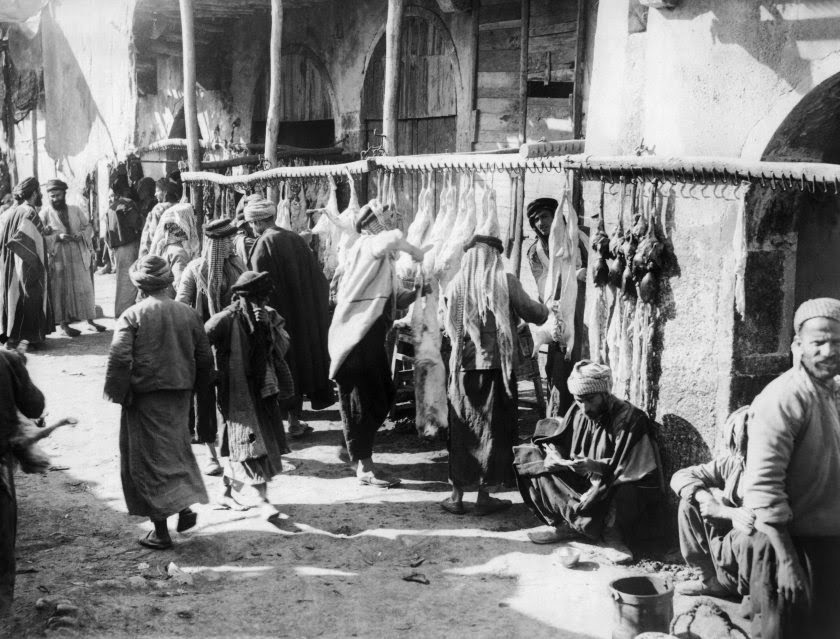
A meat market in Mosul, 1959.

Kirkuk, 1956
 I do recommend this article by Roqayah Chamseddine:
Jean Bricmont’s powerful book Humanitarian Imperialism: Using Human Rights to Sell War, written during the occupation of Iraq, is a timely historical critique of Western interventionism, one worth examining as the United States of America moves once more in the direction of military entanglement in Iraq. Bricmont, a Belgian theoretical physicist and professor at The Université catholique de Louvain, discusses the ideological factors which legitimize military action in response to humanitarian abuses and “in defense of democracy” (p. 7). — “This is the discourse and the representation that must be challenged in order to build a radical and self-confident opposition to current and future wars.” The humanitarian rationales offered under the banner of there being “a responsibility to protect” have only increased since the end of World War II, and methods to reinforce such motivations have grown progressively coercive.
Bricmont introduces a formula which will come to define “humanitarian imperialism:” when A exercises power over B, he does so for B's "own good" (p. 11). This is the creed of philanthropic power — which peddles and rationalizes war as a column maintaining international order — and which continues to define the very nature of international conflict post-World War II. Interventionism is no longer argued as being warranted in the name of Christianity, Bricmont argues, but what he calls ideological reinforcements: democracy and human rights. For example, despite former US President George W. Bush’s frequent use of religious imagery, the call to invade Iraq was not only drenched in chilling white saviourism but an overwhelming exceptionalism which contends that only military efforts led by the United States of America would bring about a just liberation and lasting stability for the people of Iraq. “[T]he dangers to our country and the world will be overcome. We will pass through this time of peril and carry on the work of peace,” George W. Bush stated in 2003. “We will defend our freedom. We will bring freedom to others and we will prevail.”

The horrors inflicted upon the people of Iraq are still understated, and since 2003 the bloodshed has not stopped. When Obama delivered his speech in 2011 celebrating the US military withdrawal, there were bombings and shootings in Baghdad, in Mosul, in Kirkuk and in Tal Afer. While the Iraqi people were preparing burial shrouds Obama was reaffirming the previous administration’s claims that the US left for the Iraqi people a stable country, had forged a lasting peace and made the world more secure. Amongst the congratulatory frill and repugnant nationalism Obama did make one salient point — that the US legacy in Iraq will endure and that it shall be remembered. The legacy of this tragic and implacable war will live on in the wombs of Iraqi women who bear children with congenital birth defects as a result of depleted uranium; the riddled bodies of those now suffering from cancer due to the toxic munitions used by the US military and finally in the land of Iraq, which has been devoured and polluted by the chemical weapons the US unleashed during its occupation.
 - Iraq intervention, redux? The folly of 'humanitarian imperialism.'


Friday, 27 June 2014

وافق شن طبقة: Toboqa is right for Shin

 It has come to my attention that the folktale I translated, 'The smart boy and the smarter girl' is very similar to an Arabic mithal (example, similar to a proverb in English) reported by Ibn al-Jawzi (a Hanbali jurist and descendent of Abu Bakr) in his 6th century AD book Al-Adhkiya', 'The smart ones' (you can read the whole thing in Arabic here).  It appears that the tale 'The smart boy' is a variant of Ibn Jawziya's story 'وافق شن طبقة', 'Toboqa is right for Shin' and may have originally came from it, or maybe they have both been around for a long time.  

The proverb 'Toboqa is right for Shin' is said when someone has found their match, or when two things are similar. 

At any rate, here is 'Toboqa is right for Shin':

قال الشرقي بن فطامي كان شن من دهاة العرب فقال والله لأطوفن حتى أجد امرأة مثلي فأتزوجها فسار حتى لقي رجلاً يريد قرية يريدها شن فصحبه فلما انطلقا قال له شن أتحملني أم أحملك فقال الرجل يا جاهل كيف يحمل الراكب الراكب فسارا حتى رأيا زرعاً قد استحصد فقال شن: أترى هذا الزرع قد أكل أم لا فقال يا جاهل أما تراه قائماً فمرا بجنازة فقال أترى صاحبها حياً أو ميتاً فقال ما رأيت أجهل منك أتراهم حملوا إلى القبور حياً ثم سار به الرجل إلى منزله وكانت له ابنة تسمى طبقة فقص عليها القصة فقالت أما قوله أتحملني أم أحملك فأراد تحدثني أم أحدثك حتى تقطع طريقنا وأما قوله أترى هذا الزرع قد أكل أم لا فأراد باعه أهله فأكلوا ثمنه أم لا وأما قوله في الميت فإنه أراد اترك عقبا يحيا به ذكره أم لا فخرج الرجل فحادثه ثم أخبره بقول ابنته فخطبها إليه فزوجه إياها فحملها إلى أهله فلما عرفوا عقلها ودهاءها قالوا وافق شن طبقة

Ash-Sharqi bin Fatami said:  Shin was one of the clever Arabs, and he said: Wallahi I will walk until I find a woman like me and marry her.  So he walked until he met a man who was going to the same village Shin was and became his companion.  When they started walking, Shin said to him: Will you carry me or shall I carry you, and the man said: O ignorant one how can a passenger carry a passenger.  They walked until they saw a farm with ripe crops, and Shin said: Do you see this crop, has it been eaten or not?  And the man said: O ignorant one, do you not see it standing there.  And they passed a funeral and Shin said: Do you think the one the funeral's for is alive or dead.  The man said: I have never seen one more ignorant than you, do you think they would carry him to his grave alive.  Then the man took Shin to his house, where he had a daughter named Toboqa, and he told her the story of what happened on the trip.  She said: as for when he said 'will you carry me or shall I carry you', he meant, will you speak to me or shall I speak to you, so as to shorten our road.  As for when he said 'do you think this crop has been eaten or not', he meant, had its owners already sold it and eaten up its price or not.  As for what he said about the dead person, he meant did he leave a descendant and so his memory lives through him or not.  The man went out and talked to Shin and then told Shin what his daughter had said and Shin proposed to her and married her and took her to his family.  When they realised her intelligence and cleverness they said, Toboqa is right for Shin.

Wednesday, 25 June 2014

The smart youth and the smarter girl

To reduce the bitter taste of that last terribly sexist folktale (I think it's right to translate all of them, pleasant or not), here's a short, sweet Omani one that's not sexist at all.  Arabic dialogue is signalled by a dash instead of quotation marks and I've left it as is. 


The smart youth and the smarter girl


A man travelled to a far country because of a job that he had to do, and when he was finished with his job he decided to return to his country, where his wife and his daughter were.  On the return trip he met a youth walking along the same road, and they met and became friends.  

After a little while they met a peasant winnowing wheat (separating the grain from the husk), and the youth asked the man:

-          Are these grains good or bad?
[And the man replied:]
-          How can I know?

On the second day they passed by a flock of sheep, and the boy asked the man:

-          Are there blessings in this flock or no?

And again the man did not know what to answer.

Another day, they saw a dead person whose family was washing him, and the youth asked the man:

-          Is he alive or dead?

The question astonished the man, and he believed the youth must be crazy.  And they continued in their journey until finally they arrived at their country.

The youth asked the man:

-          Where will you sleep?

[And the man replied:]
-          In my house of course, for I have a wife and a daughter. 

[The youth said:]
-          As for me, I will sleep in a house larger than yours; indeed it is the largest house in the country.

They split up, and when the man arrived at his house, his wife and his daughter welcomed him, and then his daughter asked him:

-          Did you come alone?

[And the man replied:]

-          There was a youth with me, I think he was crazy.

-          Why do you think that? [She asked.]

-          Because he was asking strange questions, [he replied.]

-          What questions?

-          We passed by a man winnowing wheat and he asked me whether the grains were good or bad.

-          Grains are good when their owners are not in debt, and bad if their owners accept their price before they grow [she said].

-          Then what do you say, daughter, to this:  we passed by a dead man whom they were washing and the youth asked me: is he alive or dead?

-          He meant that if the dead man had sons, then he is alive, and if he was barren, then he is dead.

-          Good, what do you say to this: we passed by a flock of sheep and the youth asked me: Are there blessings in this flock or not?

-          If there was a ram in the flock then it is blessed, for it will increase, and if not then there is no blessing in it.

The girl prepared thirty loaves of bread and a bowl of fat, and her father asked her:

-          Who is this for?!

-          For the youth who was with you.

-          Do you know where he is right now?

-          In the masjid.

-          How did you know?

-          Didn’t you tell me that he was going to stay in the largest house in the country, and is there a larger house than the house of Allah the Almighty?

Then she turned to her servant and said:

-          Say to the youth that there are thirty days in the month and the ocean is full.

In the road, the servant met a poor man and gave him a loaf and some fat, then she continued until she arrived to the youth in the masjid and gave him bread and fat and a message from her lady:

-          My lady says to you: there are thirty days in the month and the ocean is full. 

-          Say to your lady that there are twenty-nine days in the month, and the ocean is less by a wave, and do not hold the daughter of the people to account.  [Which means, do not punish your servant, for what she did was good].


From ‘Stories from the Omani Tradition’ by Yusuf ash-Sharouni (1987)


Tuesday, 24 June 2014

Spam, translated

That post where I translated a spam email gets a lot of hits, so I'm guessing a lot of people are getting spam they can't read.  Here's another one from a Russian email address:

لسلام عليكم ورحمة الله وبركاتهانا من سوريا ام وحيدة لطفلين عندى اقتراح اريد ان اقدمه لك لصالحنا انا وانت فارجو الرد بارسال بياناتك والسلام عليكم ( hsafia82@live.com

Peace and mercy and blessings of Allah upon you [I am] from Syria the single mother of two children [and] I have a suggestion I want to give you for my good and yours [so] please reply by sending your information to [email address] and peace be upon you.

This is a 411 scam trying to get your information to steal your identity or string you along sending money, do not reply.  It's a scam.

Sunday, 22 June 2014

A Woman’s Wisdom: Commentary

“So, women’s tales…” OPNO said.
“Ladies are not allowed to talk to each other, they’ll get ideas,” I said.
“This is a terrible story,” she said.
“You can tell it’s being told by men.”
I had thought, before I finished reading the last paragraph, that the story would end with them all living together and the men the women had talked to finding wives to live with them as well and so they would all have other people to talk to, especially the women, who weren’t allowed to go out, but they would not have too many people to handle.  That would be a reasonable solution.
But no.  The husbands got even more jealous and went even farther in isolating their wives and did not learn from their mistakes.  The message of the story is not ‘too much solitude and too much togetherness cause trouble, so find a middle ground,’ as I thought it would be; rather, it’s ‘jealous, controlling men will try to solve their relationship problems by becoming more controlling and will blame everyone but themselves when it doesn’t work.’
OPNO has a relative who divorced five wives for trivial things like singing once while they ironed and others could hear, and finally nobody would marry their daughters to him.  I don’t know if he learned and took responsibility for his behaviour, but going on personal experience, I doubt it.  I have been the woman in relationships with men who isolated me and tried to prevent me from talking to anyone, and they still blame those untrustworthy women for all their problems and also for not dating them now.
I really hope this is being told by men as a cautionary tale, but given that it had a happy ending and the sort of ending that is seen as normal by a lot of people (excepting the castle), I rather doubt it.