Saturday, 26 February 2011

Windstorm

A windstorm comes out of the desert, bending the few scrawny pine trees parallel to the ground and howling around buildings. One whole end of the college is open to the outside, and the wind rushes in and down corridors, rattling windows and sucking at doors. If doors are left open, and people never seem to learn to close them, they will slam them so hard that the handles fall off, sometimes hard enough that the brittle wood shatters. The narrow stone stairwells become blocked for several stories with lemming-like students, every one in turn trying to force the handle-less door open, finally deciding to double back and find a different route to their lecture, and having to shove their way through a mass of other students all going through the same process. 

The wind carries dust and grit from the desert, and pelts it against everything in reach. It drums against the windows, sands the paint off cars, and coats the cabbages and radishes in the farm plot next door with a layer of sandy brown. The wind buffets struggling pedestrians, tearing at their billowing abayas and thobes and scarves. Everyone who doesn’t wear niqab shields their face from the dust with a scarf or a book.

After a few days of howling wind and blowing sand, I wake up in the night to the sound of raindrops tapping on the windows, and rushing water. It is raining hard somewhere, and torrents of muddy water come gushing out of the desert and into the wadi, water turned the colour of chocolate milk by the soil it carries from far away. I listen to the little river behind the school roaring, the wind howling, and the pine branches rustling, and I remember the crashing waves, and the wind in fir trees, and the unearthly silence of falling snow in my former home, far away across oceans and continents, and I fall back asleep.

Monday, 14 February 2011

Photos from Jerash

I don't know what to write about, so let's have some photos. I must have several hundred just of Jerash, but these are some of my favourites.

I visited the excavated Roman ruins at Jerash several times last year, although we only actually got past the front gate once.

Here's Hadrian's Gate at the entrance to the site, built for the visit of the emperor Hadrian in 130 AD.


Some of the artifacts that have been discovered. The site has been occupied for around five thousand years; it was conquered by Rome in 63 BC, and mostly destroyed by earthquake in 749 AD. The monuments visible have all been dug up and reconstructed; there is scaffolding and a pile of stone blocks behind Hadrian's Gate, as it is still being assembled.


Most employees at historic sites don't mind having their pictures taken.

A man selling trinkets at the entrance to the South Theatre.


This 'gladiator' seemed to be having a good time striking fierce poses with his sword for the pretty foreign students.


The Hippodrome has mock Roman military demonstrations, chariot races, half-nude middle-aged Arab guys very earnestly trying to sword fight to the death, etc.


It's a big site. The air here is always more or less hazy, but you can (hopefully) see that the Cardo (north-oriented paved road bordered by pillars) winds its way all the way up the hill to the left. I was delighted the one time I was able to walk all the way through it, although I was the only one who did.


The little souvenir souq that the Turkish study groups often never leave. I just don't see the interest in it, but then I dislike shopping and knick-knacks in general. To each their own.

Thursday, 3 February 2011

Rain at Last

Jordan is mostly a very dry place. It doesn't have any major bodies of water to draw from, so it mostly depends on rainfall, which isn't that plentiful in a country that's mostly desert. What about the Jordan River? I've seen it a number of times, and from the hills it's hard to tell that it is a river, there's so little water in it.

Back in November, the Jordanian government called for people to fast for three days and then gather all over the country to pray salaat al-istisqa, the prayer for rain. There were posters everywhere, and a group prayer was held in the paved yard of my college. The rain did come, I don't recall exctly when, but shortly after the prayer. Some people will say that it was going to rain eventually anyways and praying has no effect, but personally I believe that Allah heard our prayers, forgave us, and send the rain.

Rain in the desert after nearly a year of dust and dryness is a miraculous thing to witness. The water has nowhere to go, so streets and many houses flood; the whole town is shut down and classes are cancelled, very much like the effect a few inches of snow has in a certain pathetically and chronically unprepared city in Canada.

Despite the problems it causes, children stand rapt and watch the raindrops fall, and adults rejoice. I was standing under the eaves of the masjid, sheltering from the rain while waiting for it to open, and a woman joined me. She remarked happily about how lovely the weather was, and I thought for a moment that she was joking. In Canada, pouring down rain is ordinary and dreary, but here it's a miracle that only happens a few times a year.


When it finally rains, it really rains. Water comes rushing down out of the higher desert and fills the wadis that were formally used as footpaths, playgrounds, and garbage disposal with torrents of chocolately brown water. It happens very suddenly, and I wonder every year if anyone got caught in the wadi when the water came crashing down.


Tuesday, 1 February 2011

Tombs of the Sahaba

The tomb of one of the many Sahaba who died in Jordan during the Amwaas plague outbreak in the year 18 after the Hijrah (639-640 AD). Unfortunately, I have visited a lot of their tombs and can't remember who this one belonged to. All I can make out for sure from the photo is that he was an Ansari (one of the Muslims of Medinah who helped the Muslims from Mecca after their migration to Medinah).

An estimated 25, 000 people died in the plague outbreak, including many of the Sahaba who had liberated balad ash-shams from Roman rule (or conquered it, depending on your perspective). Many people don't know that these Sahaba died of plague, and not in battle.

This tomb is not very fancy, as they go, but most of the ones I have seen are huge affairs of polished marble, golden cages, and embroidered velvet. The bravery, faith, and sacrifices of these men who died so far from home should be remembered, but erecting shrines to them seems like too much to me. It's not in keeping with the Islamic burial practices, in which the corpse is wrapped in a plain white sheet and quickly buried in the ground, to absorb back into the earth from which it was made.


I believe this was the masjid in which the tomb above was located although it may have been a different masjid holding the tombs of other Sahaba. I took the pictures last spring, and only recently had them developed.

I found it lovely, simple, and peaceful, down in the Jordan valley where things are actually green some of the time, although far richer than most of this dusty land.

It bothers me that so much is spent to glorify men dead nearly a millenia and a half, when most people here work so hard and live in poverty and difficult conditions, with little hope of anything better.


Wednesday, 29 December 2010

I'm still around.

Just busy. I'm studying in college, and at the masjid attached to my college, and tutoring English, so I don't get on the internet much. I've been trying to convince the school to stop using Internet Explorer 6, but no dice so far. It's a miracle it even still sort of works.

I've been jumping out of my skin several times every day (and night) when the fire alarm goes off. It's definitely winter now, or what passes for winter here, because the girls are leaving things to cook on the electric heaters, and of course forgetting about them and setting the fire alarms off. It would not be as annoying, if not for the fact that most of the girls in the dorm stay up most of the night, so that's when the majority of the alarms go off, and they won't go and shut them off. Getting woken up and scared out of my wits by the extremely loud bells a few times every night is getting really irritating.

I'm afraid that one day there actually will be a fire (not that it would be that big a deal, since there's not much that could burn), and I'll have rolled over and gone back to sleep, and we'll all suffocate, so I get out of bed and go deal with the alarm, and try to be patient with whoever set it off. My strong fear of fire seems very unreasonable to everyone here; I think it stems from growing up where everything was made of wood or fabric, seeing houses go up in flames like piles of tinder as a child, and having fire safety drilled into me in elementary school. I suppose to a group of very inexperienced girls who have never seen fire, it doesn't seem like anything to get worked up about.

Happy New Year to everyone :)

Thursday, 2 December 2010

Bottles of sand

These bottles full of sand are popular souvenirs in Jordan. You can get them at all the tourist sites and a lot of ordinary shops, but the cheapest place I know of is the souvenir market at the ancient Roman city of Jerash, where the tall round ones are only a dinar (about $1.50) and the larger flat ones are a few dinars.

Coloured sand is very carefully poured through a long, thin funnel into layers of little mounds into the bottle, which form the shapes of camels and mountains when you look at it from the outside of the bottle. They are sealed with a layer of sand mixed with some sort of glue; once the glue dries they won't spill. It is a very interesting process to watch, and incredibly fast.

The Turkish girls often buy a few dozen each to take back to their families. More than one group of Turkish students has loaded up at souvenirs at the market, taken photos of each other outside the main gates of Jerash, and then decided they'd had enough and wanted to go to a mall. I was very disappointed the first time, because I have no interest in malls (which the students spend a lot of time in), but would very much like to walk around some Roman ruins.

Here's Hadrian's Gate at the entrance to the ruins, one of the spots everyone has their picture taken in front of. In Roman times only emperors could enter through it; the picture really doesn't give a good idea of just how large it is.

Thursday, 25 November 2010

I've started tutoring a few of the Arab students in my dormitory in English, and discovered that almost none of them knew I could even speak English. I'm one of only two dorm dwellers this semester who isn't Saudi; the other is a Turk who speaks fairly fluent standard Arabic and studies with the Arabs in the regular college programs.

The Saudi girls seem to have just grouped me with all the other pale people with funny accents - Zarqa has a lot of Chechnyans, and quite a few Russians, Bosnians, and other Eastern Europeans. Hardly any of them knew where I was from, and even fewer of them know where Canada is. If they think Canada is one of the little Eastern European countries, it's no wonder they didn't realize I spoke English.

It's true they've never heard me speak English before, there is no one here for me to speak it with, but still, how do you live with someone for a year and not even know which country they are from and what their native language is?

Immigrants in Canada must feel even more invisible and insignificant - one more foreigner with an accent, not really an individual with a past and stories of their own.  But nobody here looks down on me.

Wednesday, 24 November 2010

Pretending to Be a Teacher

My college offered me a scholarship (yay!) and I asked if there was anything I could do for them in return, since I stay in the dorm for free. We're crammed in six to a room and not treated very well, but still. They said no, but I got back from the souq this afternoon, totally exhausted, and was just about to shower and eat and then lay down for a bit, and my instructor and an Arab student knocked on the door. The student is taking English composition but knows zero English - I don't even know why the school let her take the course, but that's Jordan for you.

So now I'm pretending that I know how to teach English, and the word is spreading, and all sorts of people want me to teach them. Most of them want an hour a day EACH, which seems unrealistic to me, especially since I'm not charging anything. Or maybe that's why they want an hour every day.

I haven't told anybody that I don't actually know English grammar myself. At all. I studied science briefly in Canada, and promptly forgot all the grammar I supposedly learned many many years ago in high school. Trying to explain English grammar in Arabic is not all that easy, especially since English grammar is nothing like Arabic grammar.

I'm going to look for a copy of the college's English textbook tomorrow, study it myself, try to figure out how to explain all this in Arabic, or very simple English, and hope nobody realizes that I have no idea what I'm doing. It's the best plan I can think of. Fake it till you make it, right?

Tuesday, 16 November 2010


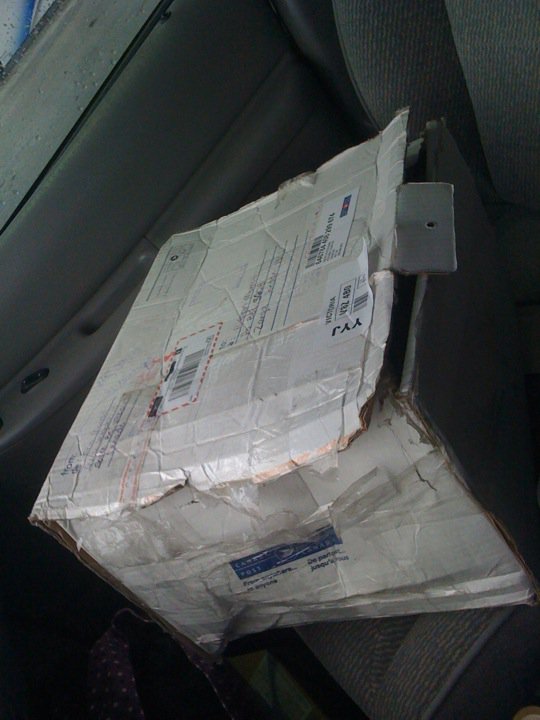
My sister in Canada mailed me this package back in March of this year. It's apparently been in and out of Jordan several times, opened and re-taped Allah only knows how many times, and to my surprise everything is still there. Unfortunately, it cost her ninety bucks in shipping, which I feel really bad about, but I'm glad she finally got it back.


I tried to pick it up, in fact I inquired at the post office quite a few times during the nearly eight months the package spent in Jordan, but they claimed no knowledge of it, or of anything else ever being sent to my post office box. I have gotten plenty of other peoples' mail; postal employees are supposed to be able to read English numbers, and read them in the right direction, because the boxes are labelled in English, but a lot of people are hired who can't reliably.


When I first arrived in Jordan, I wondered why nobody I knew ever got mail, or even had a mailing address. This would be why - it doesn't arrive. I still wonder how people go through life without using the postal system.

Saturday, 9 October 2010

Soğukçeşme Street

Soğukçeşme Sokaği ('Street of the Cold Fountain') is a lovely cobblestoned street squeezed in between the Hagia Sophia and the wall of Gülhane Park, part of the Topkapı Palace grounds. Its late 19th century wooden townhouses were restored or rebuilt in the 1980s; most of them are now run as expensive hostels. One house contains a library full of books about Istanbul.


An Ottoman water tap.
There are an art gallery and some fancy cafes, towards the end of the street.
Men carrying large trays of things through crowds are a common sight in Istanbul, but it was not crowded today.

Looking back up the street from the end:

Street art outside an art gallery:

It was the middle of a weekday in the off-season, so this cat had the cafe to itself.

A stream in shady Gülhane Park:
Gülhane Park is very popular with couples, young families, and tourists. Girls in hijab and their boyfriends are often seen kissing among the trees - maybe they think people can't see them, or they just don't care if anyone does, I don't know which.
There are birdhouses way, way up in the trees. I don't know what sort of birds they house, but they look tropical. They were too high up to get a good picture.

Begonias planted at the feet of the trees.